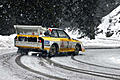
COMPARATIVA EN CIRCUITO:M3 e-46,Clio Sport 172cv,M5400cv, promo kart 125,kawasaki...

ForoCoches: Miembro
12-abr-2007 04:05
#1
|
Buenas Noches!! Pues buscando un poco en internet me he topado con esta comparativa del año 2001 en circuito de la Revista Top Car. Los modelos analizados en esta comparativa, por orden alfabético son: ----Coche---------------------------------Potencia: ---125 Promo Kart------------------------- 32cv ---Alfa Romeo 156 Selespeed-------------- 150cv ---Audi S3------------------------------- 210cv ---Audi TT---------------------------------225cv ---BMW 330i Sport-------------------------231cv ---BMW M3 (E46)--------------------------343cv ---BMW M5--------------------------------400cv ---BMW Z3 3.0i ---------------------------231 cv ---Chevrolet Lumina SS--------------------306cv ---Kawasaki ZX-12R------------------------180cv ---Mercedes-Benz C320 Avantgarde---------218cv ---Mercedes-Benz SLK 200 Kompressor------163cv ---Nissan Skyline GT-R ---------------------284cv ---Opel Petronas Astra V8 Coupé DTM-------500cv ---Peugeot 206 S16 GTi--------------------138cv ---Porsche 911 GT2------------------------463cv ---Renault Clio 2.0 Sport Fase I-------------172cv ---Saab 9-5 Aero-------------------------- 231cv ---Subaru Impreza WRX.------------------- 218cv ---Toyota Corolla RXi-----------------------156cv ---Toyota MR2 Roadster--------------------140cv ---Volkswagen Golf TDI ---------------------110cv ---Volkswagen Sharan V6 -------------------204cv ---Volvo S40 T4 ----------------------------200cv ---Volvo S60 T5 ----------------------------250cv Aquí los tiempos conseguidos Por Orden: -Car-------------------Test Driver-------------Team Topcar------------Tc performance Rating 1 PORSCHE GT2 ----------------1,11.31 sec ------------------------1,12.26 sec ---------------------------------95% 2 NISSAN SKYLINE GT-R--------1,16.05 sec-------------------------1,17.92 sec----------------------------------90% 3 BMW M5-----------------------1,16.63 sec-------------------------1,18.26 sec----------------------------------90% 4 BMW M3-----------------------1,17.30 sec-------------------------1,18.46 sec-----------------------------------85% 5 BMW Z33.0i-------------------1,18.47 sec-------------------------1,19.53 sec-----------------------------------85% 6 SUBARU IMPREZA WRX-------1,18.60 sec-------------------------1,19.91 sec-----------------------------------73% 7 AUDI TT COUPÉ---------------1,19.33 sec-------------------------1,22.36 sec-----------------------------------75% 8 BMW 330i SPORT--------------1,19.35 sec-------------------------1,20.12 sec-----------------------------------80% 9 RENAULT CLIO 2.0 SPORT-----1,19.38 sec-------------------------1,21.19 sec-----------------------------------80% 10 TOYOTA MR2 ROADSTER------1,19.75 sec--------------------------1,22.16 sec----------------------------------73% 11 AUDI S3-------------------------1,20.29 sec-------------------------1,21.85 sec-----------------------------------85% 12 CHEVROLET LUMINA SS---------1,20.40 sec-------------------------1,22.59 sec ----------------------------------50% 13 MERCEDES-BENZ SLK200 K------1,20.90 sec-------------------------1,23.54 sec-----------------------------------70% s 14 SAAB 9-5 AERO-------------------1,21.31 sec-------------------------1,21.69 sec----------------------------------78% VOLVO S60 T5----------------------1,21.92 sec--------------------------1,22.66 sec-----------------------------------75% PEUGEOT 206 S16 GTi---------------1,22.51 sec-------------------------1,23.12 sec-----------------------------------75% MERCEDES-BENZ C320----------------1,22.76 sec-------------------------1,23.83 sec-----------------------------------73% sTOYOTA COROLLA RXi---------------1,23.18 sec------------------------1,25.62 sec------------------------------------58% VOLVO S40 T4-------------------------1,23.51 sec------------------------1,25.72 sec------------------------------------75% s 20 ALFA ROMEO 156 SELESPEED------1,25.16 sec------------------------1,26.58 sec------------------------------------73% 21 VW GOLF TDI-----------------------1,26.94 sec------------------------1,26.91 sec------------------------------------58% 22 VW SHARAN V6----------------------1,27.27 sec------------------------1,27.86 sec------------------------------------70% * KAWASAKI ZX-12R-----------------------1,17.68 sec * 125 PROMO KART------------------------1,12.67 sec * PETRONAS OPEL ASTRA V8 COUPÉ------1,03.33 sec Decir que me han sorprendido gratamente los tiempos del Kart, el CLio Sport fase I 172cv y el del toyota Mr2. Aquí la comparativa; que aproveche: Clio 2.0 Sport (Lap it up! Top Car 06.2001) It's that time of year again - Topcar's annual performance feature. And this year we've gone big with a selection of 25 performance machines ranging from all-out exotics to pukka race machines. The goal? To set the fastest possible lap time around the brand new Zwartkops Raceway situated between Johannesburg and Pretoria. Time to buckle up for the ride of your life! Photography: MARC BOW  Bigger and better. That, in a nutshell, is what the Topcar team set out to achieve with our 2001 performance feature. Bigger and better. That, in a nutshell, is what the Topcar team set out to achieve with our 2001 performance feature.Although we get to drive our fair share of performance machines during normal road test evaluations, it's often the case that, apart from performance testing at Gerotek, there's little opportunity to savour their true potential. So, instead of revelling in the thrills of accelerating hard through the gears or challenging the laws of physics around corners, a more likely scenario is one of traffic jams and less than understanding traffic authorities. And this means that there is real reason why we would want to throw caution to the wind, don our racing helmets and aim to drive like demons. Apart from the element of excitement involved, it gives us the opportunity to assess and evaluate some of the best performance machines available in South Africa.  Last year, Topcar's performance feature placed all-out emphasis on acceleration and braking. We chose the legendary Tarlton International Raceway as a venue where 18 cars and one motorbike were subjected to an arduous 0-160-0 km/h test. Last year, Topcar's performance feature placed all-out emphasis on acceleration and braking. We chose the legendary Tarlton International Raceway as a venue where 18 cars and one motorbike were subjected to an arduous 0-160-0 km/h test.This year we devised an even tougher, more complete test for our prospective contenders focussing on the three main aspects related to performance vehicles: acceleration, braking and handling. Our chosen venue was the recently completed Zwartkops Raceway, situated on the border between Johannesburg and Pretoria West. Building on the heritage of the original track that opened in 1961, the brand new 2,4 km circuit is the culmination of a R17-million investment. The main purpose of the new track is to provide the motorsport enthusiast with an up-close and personal viewing experience - something that's been sadly neglected at many of SA's other premier racing circuits.  While pleasing crowds was the last thing on our minds, the tight circuit proved ideal for a track test of this nature. Zwartkops is sufficiently short so as not to place undue stress on the vehicles, but enough of a challenge to evaluate each contender thoroughly. While pleasing crowds was the last thing on our minds, the tight circuit proved ideal for a track test of this nature. Zwartkops is sufficiently short so as not to place undue stress on the vehicles, but enough of a challenge to evaluate each contender thoroughly.A lap at Zwarkops runs as follows: once past the pit straight there's a mild left-hander that quickly throws you into the slow, right hairpin. Once through, it's open taps all the way, flowing along the long, fast right-hander that closes up in a more intentional sweep in the same direction. Then it's up the hill towards the double tight right-hander at the top of the track. A short race down to the final left-hander leading to the pit straight and you're done. Short, fast and to the point. So what exactly did the test involve? In simple terms, with traction control disabled, it meant driving each car around the track as fast as possible. Only three laps were allowed: an out lap, one fast lap and a cooling down lap - nothing more.  This meant that each driver had relatively little time to get accustomed to a vehicle. And since each car responds differently to another, posting a competitive lap with such time constraints was where the catch lay. This meant that each driver had relatively little time to get accustomed to a vehicle. And since each car responds differently to another, posting a competitive lap with such time constraints was where the catch lay.There was simply no time to get to grips with any vehicle's specific handling traits which meant that the more driver-friendly it was, the easier it would be to post a fast lap time. Alternatively, should the car require delicate inputs best learnt over a long period of driving intimacy, clocking a fast lap time would be extremely difficult. For this test we decided to invite former multiple SA touring car champion Giniel de Villiers as the main test driver. His expertise and driving knowledge would prove a vital asset to this test. De Villiers would be given the opportunity to set a yardstick lap time in each car after which Team Topcar would try and match it.  At the end of each track session, both De Villiers and the Topcar driver had to answer five questions relating to 'performance', 'grip', 'steering feel and accuracy', 'brakes', and an 'overall' assessment. Two scores out of 10 were recorded and later used to calculate our Topcar Performance Rating, represented as a percentage (below). At the end of each track session, both De Villiers and the Topcar driver had to answer five questions relating to 'performance', 'grip', 'steering feel and accuracy', 'brakes', and an 'overall' assessment. Two scores out of 10 were recorded and later used to calculate our Topcar Performance Rating, represented as a percentage (below).It's important to note that this performance score relates to the car's performance on the track and not as an assessment on its overall everyday ability. For the purposes of this test, we selected a varied group of cars drawn from very different market segments with the only common denominator their performance appeal. With a combined value of over R8-million, there was no lack of choice either, and as is usually the case, choosing what to drive next posed a serious dilemma.  Also note that the cars don't compete head on for overall honours as it's quite obvious that an MPV stands no chance against a super car. Also note that the cars don't compete head on for overall honours as it's quite obvious that an MPV stands no chance against a super car.Some of the cars are direct rivals and their results can be compared as such. In most cases, though, this group simply represents the very best in mass produced performance machinery. The list is as compelling as it is tantalising. Here they are in alphabetical order: Alfa Romeo 156 Selespeed Audi S3 Audi TT BMW 330i Sport BMW M3 (E46) BMW M5 BMW Z3 3.0i Chevrolet Lumina SS Mercedes-Benz C320 Avantgarde Mercedes-Benz SLK 200 Kompressor Nissan Skyline GT-R Peugeot 206 S16 GTi Porsche 911 GT2 Renault Clio 2.0 Sport Saab 9-5 Aero Subaru Impreza WRX Toyota Corolla RXi Toyota MR2 Roadster Volkswagen Golf TDI Volkswagen Sharan V6 Volvo S40 T4 Volvo S60 T5 Finally it's time to strap yourself in and enjoy the ride! Welcome to the 2001 Topcar performance feature. Topcar performance rating: 100 to 90% Excellent 89 to 70% Good 69 to 50% Average 49 to 0% Poor GINIEL DE VILLIERS Our man in the hot seat  Fans of South African motorsport need no introduction to Giniel de Villiers. He's been SA Touring Car champion four times in a row from 1997 to 2000 as a member of the BP Nissan Primera team. Fans of South African motorsport need no introduction to Giniel de Villiers. He's been SA Touring Car champion four times in a row from 1997 to 2000 as a member of the BP Nissan Primera team.In 1994, De Villiers competed in Group N production car racing driving a Nissan Sentra in class B. He was production car champion that year as well. It was way back in 1989 when it all started. He entered his first Clubmans race in an Opel Kadett and never looked back. So as an experienced racing driver, De Villiers seemed highly qualified to be our honorary performance feature test driver. Of course we had high expectations and if anything, De Villiers certainly had his work cut out for him ... But then, not much fazes this relaxed 29-year-old. His easy-going demeanour, unquestionable professionalism and naturally his talent behind the wheel, made the lengthy process of driving each contender a quick, hassle-free exercise. Currently, De Villiers is competing in the tough, uncompromising world of off-road racing. He's sticking to Nissan and campaigns a Hardbody Double Cab that, quite frankly, is as mean as they come. It seems that motorsport will remain an integral part of Giniel de Villiers' life for many years to come. And apart from his undoubted talent behind the wheel, his friendly, relaxed attitude will see him enjoy plenty of support and many more successes during his career. PORSCHE 911 GT2  It was no real surprise that Porsche's latest incarnation of its legendary 911 completely dominated this track test, beating its closest rival by almost five seconds! It was no real surprise that Porsche's latest incarnation of its legendary 911 completely dominated this track test, beating its closest rival by almost five seconds!But then, the GT2 is simply phenomenal. It looks, performs and handles like a thoroughbred super car - which, after all, is exactly what it is. As the fastest member of the 911 clan, the GT2 combines the extreme, sporting character of the GT3 with the towering performance of the Turbo, but in a race-ready package. And best of all - it's rear-wheel drive. As the only GT2 in the country, we were lucky to get our hands on this R2,3-million super car. And with claimed performance figures of 0-100 km/h in 4,9 sec and 0-200 km/h in 12,9 sec, the GT2 clearly had 'winner' written all over it. Under that deliciously shaped rear wing lies the usual 3,6-litre horizontally opposed flat six engine fitted with twin turbochargers. This power plant is a high performance version of the engine found in the Turbo with increased boost pressure.  It offers 10 percent more power than the Turbo, allowing for a full 340 kW to be developed at 5 700 r/min accompanied by 620 Nm of torque. It offers 10 percent more power than the Turbo, allowing for a full 340 kW to be developed at 5 700 r/min accompanied by 620 Nm of torque.Porsche states that the focus in developing the GT2 was on power and performance to the extreme. The objective was to not only boost engine power, but also reduce the weight of the car. And weighing in at only 1 440 kg, the GT2 sports a power-to-weight ratio of 236,1 kW per ton! De Villiers had the first crack behind the wheel, managing a best lap time of 1 min 11,31 sec - eclipsing the second-placed Skyline GT-R by 4,74 sec.  He had very little to say about the performance, merely stating that it is simply superb. The brakes were awesome, the steering excellent and the levels of grip astonishing. He did, however, have one slight irritation in the understeer creeping in at the limit. He had very little to say about the performance, merely stating that it is simply superb. The brakes were awesome, the steering excellent and the levels of grip astonishing. He did, however, have one slight irritation in the understeer creeping in at the limit.Team Topcar took to the wheel next and raced across the line in 1,12.36 sec. It was decided there and then that the GT2 is simply the best all-round 996-series Porsche around that feels perfectly at home on the track. We rated the grip as unbelievable, but also commented on the high level of understeer dialled into the chassis. However, we were informed by the Porsche SA folk that this is a safety requirement and that the suspension can be adjusted for a more neutral attitude. Overall both De Villiers and the Topcar team scored this car 9,5 out of 10, giving it top marks in the Topcar Performance Rating: a dominating 95 percent. This car provides a combination of acceleration, handling and braking that simply surpasses any other road car featured here. NISSAN SKYLINE GT-R V-SPEC  Nissan's devilish GT-R reminds one of a pit bull terrier. Ugly and ferocious with an in-your-face, mean-ass attitude. This car doesn't want to be your friend, it wants you to work it, and work it hard. Nissan's devilish GT-R reminds one of a pit bull terrier. Ugly and ferocious with an in-your-face, mean-ass attitude. This car doesn't want to be your friend, it wants you to work it, and work it hard.As one of Japan's most celebrated performance cars, the GT-R has developed an immense cult following all over the world. Thanks to a racing pedigree spanning over 200 victories and five consecutive championship wins in the All-Japanese Touring Car Championships, the GT-R has reason to make competitors go weak at the knees. Power comes from a 2,6-litre twin turbo straight six developing 209 kW. Nothing spectacular, perhaps, but linked with almost 400 Nm of torque and a close-ratio six-speed Getrag gearbox, devouring most other cars won't pose a problem for the GT-R. More than anything else, the GT-R is about sheer handling ability. Featuring Nissan's race developed Attesa-E-Ts Pro electronically controlled four-wheel drive system, an active limited slip differential and Super Hicas four-wheel steering, the V-spec really makes child's play of any kink in the road.  In normal driving conditions 100 percent of the power is directed to the rear wheels. Speed sensors on all four wheels, longitudinal and lateral 'g' sensors all analyse the vehicle's traction and stability as well as the driver's intent every 100th of a second. In normal driving conditions 100 percent of the power is directed to the rear wheels. Speed sensors on all four wheels, longitudinal and lateral 'g' sensors all analyse the vehicle's traction and stability as well as the driver's intent every 100th of a second.Should conditions require it, up to 50 percent of the engine's torque can be directed to the front wheels within milliseconds. The Super Hicas steering system is designed to eliminate any excessive understeer and can actively adjust the vehicle's rate of yaw to set the rear wheel angle for better cornering stability. De Villiers knows the GT-R well from previous encounters, but had never driven the car at Zwarkops. After posting a best time of 1,16.05 sec, there was no denying that both car and driver were very much at home.  While performance and steering feel were natural highlights for De Villiers, he raved about the car's ability to change direction at the drop of a hat. While performance and steering feel were natural highlights for De Villiers, he raved about the car's ability to change direction at the drop of a hat.Team Topcar shared De Villiers' positive comments and agreed on the car's excellent chassis control and overall balance. We did, however, note that high revs are needed to extract the best from the engine. The GT-R V-Spec has to rate as one of the most accomplished super cars ever to emerge from the land of the rising sun, scoring 90 percent overall. BMW M5  One realises quickly that the M5 is far more than just a swanky set of executive wheels. Every aspect of the car has been tailored to the enthusiast - from the hand-assembled V8 engine to the way the chunky sports steering wheel fits into your hands. This car was born to be driven. One realises quickly that the M5 is far more than just a swanky set of executive wheels. Every aspect of the car has been tailored to the enthusiast - from the hand-assembled V8 engine to the way the chunky sports steering wheel fits into your hands. This car was born to be driven.How else could it be with an engine fit enough for a super car, a chassis so unflawed it's almost foolproof and a heritage spanning many proud, eventful years. One could wax lyrical about this car forever, but there is simply no other large, executive car that so successfully combines super car ability with all-round user friendliness. Period. At the heart of the M5 is a brutally powerful 5,0-litre V8 engine capable of delivering a Ferrari-crunching 294 kW linked to 500 Nm of torque. All of that is fed to the rear wheels via a six-speed manual gearbox.  As a fairly short and tight track, Zwartkops could be considered a tough challenge for this 1,8 ton saloon. After the first few laps, though, it became evident that this BMW had the ability to simply shrug off whatever surprises the circuit could dish up. As a fairly short and tight track, Zwartkops could be considered a tough challenge for this 1,8 ton saloon. After the first few laps, though, it became evident that this BMW had the ability to simply shrug off whatever surprises the circuit could dish up.In the hands of De Villiers, the M5 scorched around the track in 1,16.63 sec making it the third fastest. In fact, it even beat the smaller, newer and supposedly more nimble E46 M3! De Villiers commented on the superb power delivery, stating that a mass of power is available at any time. He did complain that there was a bit too much understeer for his liking.  Overall De Villiers rated the car as brilliant, scoring it nine out of a possible 10 points labelling it one of the best cars he's ever driven around a track. Overall De Villiers rated the car as brilliant, scoring it nine out of a possible 10 points labelling it one of the best cars he's ever driven around a track.Team Topcar was as impressed and managed an equally impressive 1,18.26 sec during the fast lap. With regards to performance the team agreed that this car is almost stupidly quick and you need to keep your right foot under control in order to place all those horses firmly on the track. We were more critical about the steering, deciding that it felt a bit light under track conditions, but there was no doubt as to its precision and accuracy. The brakes were praised for the impressive bite and resistance to fade. Overall, the M5 rated highly in the Topcar Performance Rating scoring a superlative 90 percent. BMW M3  BMW's long-awaited E46 M3 was an unexpected entrant to our performance test, but we were nonetheless most pleased to welcome this exciting newcomer to its first real Topcar baptism of fire. BMW's long-awaited E46 M3 was an unexpected entrant to our performance test, but we were nonetheless most pleased to welcome this exciting newcomer to its first real Topcar baptism of fire.To say that we had high expectations of this car is a complete and utter understatement. The M3 has always been BMW's quintessential performance car - a car that sets real performance standards and, in this case, we expected nothing less. Visually, there's no mistaking its identity as the fastest of the 3-Series family. Those extra-wide wheel arches filled to the brim with 18-inch wheels and tyres, the four chromed tailpipes and that aggressive power bulge rising above the aluminium bonnet all combine to give the M3 an unforgettable presence. Its primary weapon is the M-developed version of BMW's fantastic straight six, 24-valve power unit so synonymous with the brand, and the 3-Series in particular. But that's where the similarity ends. Drawing on expertise from BMW's Formula One outfit, the M3's engine is a cutting edge, high-revolution design allowing it to spin all the way to an eye-watering 8 000 r/min redline.  And then there's the sound. There's no accurate way to describe it other than as somewhere between a superbike scream and a high-speed turbine. It's simply intoxicating. And then there's the sound. There's no accurate way to describe it other than as somewhere between a superbike scream and a high-speed turbine. It's simply intoxicating.Luckily all the noise is accompanied by sufficient grunt. With 252 kW on tap, BMW claims a 0-100 km/h time of only 5,2 sec - a figure that feels entirely realistic. Out on the track De Villiers posted a best flying lap time of 1,17.30 sec, less than a second slower than it's bigger M5 brother. While his comments on the brakes, steering and performance were all overly positive, he battled to get to grips with the gearchange, as changing down to second was not as intuitive as expected. With only about 1 200 km on the clock, this car arrived with practically brand new tyres, which seemed to give way to excessive understeer too. Team Topcar agreed that this particular car suffered from too much understeer, but felt that every other aspect of the car deserved high praise. We noted that the brakes were simply superb, as were the steering feel and accuracy. Overall the car felt extremely balanced around the track except for the previously mentioned understeer, which dominated, unless thrown into the corners with aggression. Scoring 85 percent, the M3 didn't do as well as expected, but it still rates as probably the most accomplished sports coupÉ around. BMW Z3 3.0i  Completing the top five places was yet another BMW with the Z3 roadster producing a surprising result. Completing the top five places was yet another BMW with the Z3 roadster producing a surprising result.Armed with BMW's celebrated M54 3,0-litre straight six motor, a reasonably light weight body and nimble chassis reflexes, this new specification Z3 seemed set to prove a point - and that's exactly what it did. With De Villiers behind the wheel, the Z3 was brought home in 1,18.47 sec, little over one second slower than the new M3. Considering that the pre-face-lifted Z3 was often criticised for its handling inadequacies, the new car's achievement shouldn't be scoffed at. Thanks to tightened up suspension geometry and 17-inch wheels and tyres, the Z3 corners with greater poise while  manifesting improved handling precision. It does, however, come at the expense of a slightly firmer ride. manifesting improved handling precision. It does, however, come at the expense of a slightly firmer ride.While that might be a criticism on the open road, the Z3 took to the track like the proverbial duck to water. The 170 kW 2 979 cc engine also supplies ample muscle which, linked with all of 300 Nm of torque from only 3 500 r/min, means the Z3 has a healthy appetite for speed. Both De Villiers and Team Topcar were in total agreement that this car offers great power delivery, responsive acceleration with ample grunt through the gears. Similarly, the brakes performed faultlessly, resisting fade completely.  The steering feel was excellent allowing for precise placement on the track. Going sideways was no problem either but in general, the car's neutral attitude was commended. The steering feel was excellent allowing for precise placement on the track. Going sideways was no problem either but in general, the car's neutral attitude was commended.De Villiers was happy to report that this car felt far more responsive to him than the previous 2,8-litre version with improved steering feel, a crisper turn-in and an almost total lack of understeer. This car is great fun to drive around a track, involving the driver in everything that happens from moments after the accelerator is pressed to when the anchors are applied. We also liked the greater feel from the steering and the firm ride that communicates all vital information to the driver. Overall the Z3 3.0i scores highly in this test, proving that it's not merely a pretty face. It scored 85 percent in the Topcar Performance Rating. SUBARU IMPREZA WRX  There's not much one could say about the Subaru Impreza that hasn't been said before. The rally heritage, the four-wheel drive, the big turbocharger - it's all still there. There's not much one could say about the Subaru Impreza that hasn't been said before. The rally heritage, the four-wheel drive, the big turbocharger - it's all still there.In its latest WRX guise, the top-line performance Impreza has widely been criticised for losing the hard-edge appeal of its predecessor in favour of more refinement and greater comfort. And yes, to a certain extent, this Impreza is a little mild compared to what we had before. Powered by a 2,0-litre 16-valve intercooled turbocharged engine, the WRX has 160 kW at its disposal. This is linked to 292 Nm of torque developed at 3 600 r/min. A five-speed manual gearbox distributes the power. The Impreza incorporates Subaru's All-Wheel Drive system that features a limited slip differential, a viscous coupling unit and a centre diff.  In normal driving conditions, power is split equally between the front and rear wheels, but should a loss of traction be detected, a proportional amount of torque is directed to the wheels with traction to ensure optimum grip. In normal driving conditions, power is split equally between the front and rear wheels, but should a loss of traction be detected, a proportional amount of torque is directed to the wheels with traction to ensure optimum grip.De Villiers was disappointed with the performance from the 2,0-litre flat-four turbo motor, expecting much greater acceleration. Despite this, his best time of 1,18.60 sec was rapid indeed, placing the Impreza in a commendable overall sixth place. Furthermore De Villiers enjoyed the precise, positive steering and the excellent fade-free brakes. He also commended the high levels of outright grip and switch-like precision of the gearchange. Like most other four-wheel drive vehicles, the Impreza suffers from some understeer in tighter corners, although it didn't appear too much of a hindrance in cracking a good time. Overall De Villiers enjoyed the Impreza's abilities, stating that it offers a well-balanced performance package.  Team Topcar's time of 1,19.91 sec underlines the strong performance potential of this car. We agreed that there was some turbo lag under 3 500 r/min, making the correct gear selection crucial to avoid bogging down. Team Topcar's time of 1,19.91 sec underlines the strong performance potential of this car. We agreed that there was some turbo lag under 3 500 r/min, making the correct gear selection crucial to avoid bogging down.We experienced more understeer during our run and after the first few corners, the brakes started losing their bite. We felt that the steering was accurate but there was a constant battle to stop the front end from washing into understeer. Nonetheless the WRX remains a class act and scored 73 percent in the Topcar Performance Rating. Performance, great overall balance and driver enjoyment ensures that the WRX still leads the pack in many respects. AUDI TT COUPÉ  Audi's super-sexy TT coupÉ is often labelled as nothing more than a poser, only suitable for Sandton kugels and wanna-be boy racers. Fortunately, this is far from the truth. Audi's super-sexy TT coupÉ is often labelled as nothing more than a poser, only suitable for Sandton kugels and wanna-be boy racers. Fortunately, this is far from the truth.Audi's superb 20-valve 1,8-litre turbocharged four-cylinder does duty in the TT and manages 165 kW at 5 900 r/min and 280 Nm of torque from 2 200 r/min onwards. Naturally, the quattro all-wheel drive system is standard, with a close-ratio six-speed 'box transferring power to the wheels. The TT was the first Audi to be fitted with a newer generation of the quattro system. Incorporating an electro-hydraulically controlled torque distribution system, it allows for better in-corner responsiveness while resisting characteristic four-wheel drive understeer. Combined with super-fast steering, nimble chassis and firm suspension set-up, the TT seemed well suited to track conditions.  De Villiers felt that the multi-valve engine had too much turbo lag, which saw the car bogging down in the slower corners. He was more complementary about the mid-range punch and said that it was hard to believe the engine displaces only 1,8 litres. De Villiers felt that the multi-valve engine had too much turbo lag, which saw the car bogging down in the slower corners. He was more complementary about the mid-range punch and said that it was hard to believe the engine displaces only 1,8 litres.While his comments on steering feel and accuracy were positive, De Villiers felt that the brakes were the car's biggest let-down. The pedal lacked sufficient feel and after only one hard lap, excessive fade started creeping in. Overall balance in the long sweep was another highlight for De Villiers and he concluded by saying the TT is a fun-to-drive package that offers more than just cool looks. His lap time of 1,19.33 sec took the TT to seventh overall.  Team Topcar quickly noticed the lack of sufficient braking prowess during the initial laps. Braking early was a necessity, which meant that entry speeds into corners were much lower than during De Villiers' run. This resulted in us posting a rather lack-lustre 1,23.36 sec lap time. Team Topcar quickly noticed the lack of sufficient braking prowess during the initial laps. Braking early was a necessity, which meant that entry speeds into corners were much lower than during De Villiers' run. This resulted in us posting a rather lack-lustre 1,23.36 sec lap time.While we agreed on the unnecessarily high amount of turbo lag low down the rev range, the quick, nimble steering, good chassis feedback and more responsive four-wheel drive system rated as undoubted TT highlights. When all was said and done, the TT emerged as an impressive sports coupÉ. It's definitely more sports car than out-and-out race car, which in the real world out there, is probably what buyers are after. |
Editado: 17-abr-2007 18:34 -
ForoCoches: Miembro
12-abr-2007 04:47
#2
|
Seguimos: BMW 330i SPORT BMW's 3-Series makes another appearance in the top 10 with a contender that has to rate as one of the most competent driver's cars available today - the 330i Sport. What the Sport refers to is a slightly revised sports suspension with stiffer struts, stunning 17-inch alloy wheels and subtly restyled front and rear bumpers. Inside, there are more supportive front seats and a three-spoke sports steering wheel. Apart from the suspension and wheels, these are merely cosmetic add-ons. The real gem in the 330i's jewel box is the same 3,0-litre straight six engine as found in the Z3 roadster. Naturally, with the extra weight of the 3-Series body, the 330i doesn't pack the same outright punch as the Z3 but, believe us, the 330i is no slouch. De Villiers posted a best lap time of 1,19.35 sec - only 0,02 sec slower than the much nimbler TT. He pointed out that the car's exceptional grip and poise aided this impressive lapping performance. The steering felt good and the turn-in was reasonably crisp, although slight understeer was again evident in the tighter corners - obviously dialled into the chassis for greater everyday safety. The brakes also impressed the racing driver, offering good, consistent retardation with absolutely no fade to speak of. While lacking the outright stopping power of the M3, the Sport's anchors are certainly up to the job. In general, De Villiers found the 330i most exciting to drive around the track, and best of all, it's equally competent in and around town as well. Team Topcar managed to register an equally respectable time of 1,20.12 sec, again highlighting the car's easy-going nature in press-on situations. We liked the smooth power delivery from the word go, with ample torque on tap for the track's slower sections. The five-speed manual gearbox offered quick, precise shifts and the gearing seemed well suited to cut and thrust track use. Under heavy braking we experienced some tail-happy antics, although the driver never had cause for concern. Similarly, we liked the steering which offered a precise feel, allowing the car to be placed on the track with complete accuracy. Scoring 80 percent in the Topcar Performance Rating, this car undoubtedly rates as the most exciting four-door E46 model available in SA. It's a car that caters equally well for the driving enthusiast and top-flight executives. RENAULT CLIO 2.0 SPORT  Renault's hottest locally available hatchback ruffled some high and mighty feathers during our track test. Finishing ninth overall, it pipped Audi's turbocharged S3, outshone the Corvette-powered Chevrolet Lumina and made rival Peugeot's 206 GTi eat some unwelcome dust. Renault's hottest locally available hatchback ruffled some high and mighty feathers during our track test. Finishing ninth overall, it pipped Audi's turbocharged S3, outshone the Corvette-powered Chevrolet Lumina and made rival Peugeot's 206 GTi eat some unwelcome dust.Strung like a piano wire, the Clio Sport feels like a race car. The fast steering, superb chassis, quick shifting five-speed gearbox and powerful 2,0-litre engine give this Clio undeniable track presence that translates into explosive performance. After all, as they say, dynamite comes in small packages. While the Sport is a car of compromises in everyday conditions, on the track it feels entirely at home. Here you don't care about the hard ride, raucous engine and lack of outright practicality. This is a car that lives to be challenged.  The best lap time of 1,19.38 sec testifies that the Clio should be taken very seriously in a performance context. Consider that it was less than one second slower than the turbo-charged Impreza WRX and 0,91 sec faster than Audi's hot hatch S3 - and you catch our drift. The best lap time of 1,19.38 sec testifies that the Clio should be taken very seriously in a performance context. Consider that it was less than one second slower than the turbo-charged Impreza WRX and 0,91 sec faster than Audi's hot hatch S3 - and you catch our drift.De Villiers was impressed with the good, usable power although high revs are required to extract the best from the race-tuned 16-valver. Despite 124 kW going through the front wheels, there was no sign of torque steer. Also impressive were the positive steering feedback and powerful all-disc braking system that managed to successfully squeeze speed out of the Clio time and time  again, with no fade to speak of. again, with no fade to speak of.De Villiers summed the Clio up as a small race car for the performance freak. With Team Topcar behind the wheel, the Clio again impressed. We liked the great response from the engine, the superlative grip in tighter corners and the crisp, accurate steering. Our best time of 1,21.19 sec is well off De Villiers' time mainly due to some unexpected understeer creeping in at the top double right-hand section of the track. Overall a great little pocket rocket that simply puts a smile on your dial every time you slip behind the wheel and take to the road. TOYOTA MR2 Roadster  Proving that cubic centimetres aren't necessarily the best way to achieve fast track times, Toyota's mild-mannered MR2 Roadster scorched into 10th place with a best lap time of 1,19.75 sec - more than a second faster than the supercharged Mercedes-Benz SLK 200 Kompressor. Proving that cubic centimetres aren't necessarily the best way to achieve fast track times, Toyota's mild-mannered MR2 Roadster scorched into 10th place with a best lap time of 1,19.75 sec - more than a second faster than the supercharged Mercedes-Benz SLK 200 Kompressor.Introduced to celebrate Toyota SA's 40th anniversary, the mid-engined MR2 has classic status written all over it. Its sole purpose is to deliver an enthralling driving experience with completely individual styling Élan. Tucked neatly behind the rear seats lies Toyota's 1,8-litre VVT-i (Variable Valve Timing - intelligent) engine credited with a mere (at least in this company) 103 kW and 170 Nm of torque. While that might sound extremely boring, consider that the MR2 weighs less than 1 000 kg. This translates into a more than favourable power-to-weight ratio. Toyota claims a 0-100 km/h time of only 7,9 sec and a top speed of 210 km/h.  But it's the way the MR2 turns corners that's real cause for excitement. The mid-engine layout, rear-wheel drive and near perfect weight distribution seemed ideally suited to track use and so it proved. But it's the way the MR2 turns corners that's real cause for excitement. The mid-engine layout, rear-wheel drive and near perfect weight distribution seemed ideally suited to track use and so it proved.While De Villiers would have liked more power for the track, he couldn't stop talking about the brilliant, kart-like chassis responses, excellent turn-in and superlative cornering balance. He wanted more bite from the brakes however, although they never faded during his time on the track. For Topcar, the MR2 is quite simply one of the best roadsters money can buy. This is a real driver's car that provides undiluted motoring nirvana. We also agreed that more power would be welcome for track use and that maintaining momentum was important out on the track.  Turn-in was unbelievably crisp, while the neutral behaviour of the chassis with power oversteer on command kept us involved all the time. The short, snappy throw of the 'box made changing gears an intuitive exercise. Turn-in was unbelievably crisp, while the neutral behaviour of the chassis with power oversteer on command kept us involved all the time. The short, snappy throw of the 'box made changing gears an intuitive exercise.We couldn't fault the ability of the brakes to slow the MR2 down with rapid intent, although we would also have liked a bit more feel through the pedal. More importantly, though, was that the brakes continued resisting fade right until the very last lap. In need of more power for the track, the MR2 managed 73 percent in the Topcar Performance Rating, which is perhaps not as high as expected. Overall though, the car excels in offering driving enjoyment of the purest form. AUDI S3  As the first of Audi's 'S' performance models to be launched locally, the S3 had a lot to live up to. Especially with key words like 'turbo', 'quattro' and 'six-speed' as part of the description, Audi's hottest hatch needed to make its mark. As the first of Audi's 'S' performance models to be launched locally, the S3 had a lot to live up to. Especially with key words like 'turbo', 'quattro' and 'six-speed' as part of the description, Audi's hottest hatch needed to make its mark.After road testing the vehicle some months ago, we discovered the S3 to be a highly competent, fast and thoroughly entertaining driving machine. One question remained - how would it perform on a racing track? It certainly seemed well equipped for the job at hand. Under that aggressive front bonnet lies practically the same 1,8-litre 20-valve turbocharged engine as in the TT, except that it produces slightly less power and torque. With 154 kW available from 5 800 r/min, the S3 jumps out of the blocks at an alarming rate. There's plenty of torque available from little over 1 500 r/min, helping to all but banish annoying turbo lag - a malady of the more powerful TT.  After posting a best lap time of 1,20.29 sec, De Villiers was most impressed with the Audi. He immediately spoke about the impressive amount of available power and just how well the quattro system puts it all down onto the road. After posting a best lap time of 1,20.29 sec, De Villiers was most impressed with the Audi. He immediately spoke about the impressive amount of available power and just how well the quattro system puts it all down onto the road.On the handling front, De Villiers felt that the S3 was more balanced that the TT with almost no lift-off oversteer to speak of. He added that the car's chassis is so composed that it really lets you do whatever you want behind the wheel without feeling that the car might 'bite' back. Steering feel and accuracy were faultless according to De Villiers with positive responsiveness and tangible feedback. He also had no problem with the brakes, commenting that they stopped the S3 first time, every time. Team Topcar's stint behind the wheel proved much the same. We posted a time of 1,21.85 sec, which is only 1,56 sec slower than De Villiers' time. We also enjoyed the ample grunt from the engine and how the neutral composure of the car allows for accurate placement on the track. The top twin right-hand bends produced a slight amount of understeer, but nothing to really cause concern. While the steering couldn't be faulted, we disagreed with De Villiers' previous comments regarding the brakes. We experienced lots of fading and a lack of confidence in the all-disc set-up. It seems that excessive heat build-up and poor ventilation was to blame here. Overall a sublime hot hatch representing an excellent performance package. CHEVROLET LUMINA SS  It's big. It's bold. It's in your face. And it has a heart as American as apple pie. It is of course the imposing Chevrolet Lumina SS, signalling the return of the famous marque to South Africa. It's big. It's bold. It's in your face. And it has a heart as American as apple pie. It is of course the imposing Chevrolet Lumina SS, signalling the return of the famous marque to South Africa.While this Lumina actually stems from Down Under, it's 5,7-litre V8 engine has been culled from the Corvette, giving this large family saloon all of 225 kW and 460 Nm of torque at 4 400 r/min. You want American horses? The Lumina has plenty of them lurking beneath the huge bonnet. And there will be no mistaking an SS either. There are enough wings and skirts to fly a plane while the attractive 17-inch alloy wheels underline its performance potential. Oh, and don't forget the large diameter chrome tailpipe ... Although two models are currently available of which one has a six-speed manual gearbox, we could only get our hands on the four-speed auto version, which is hardly ideal for track use. Nonetheless, with De Villiers behind the wheel the SS crossed the line in 1,20.40 sec, placing it near the middle of the field. While De Villiers enjoyed the abundance of power, it was no surprise that he criticised the auto 'box's lack of precision.  He was more impressed with the overall handling of the car stating that, despite its size, the Lumina manages to track the chosen line with reasonable confidence. Quite surprisingly, it wasn't very tail-happy either. Steering felt good with a fairly quick turn-in, but again some safety-sure understeer saw valuable time tick by. He was more impressed with the overall handling of the car stating that, despite its size, the Lumina manages to track the chosen line with reasonable confidence. Quite surprisingly, it wasn't very tail-happy either. Steering felt good with a fairly quick turn-in, but again some safety-sure understeer saw valuable time tick by.The brakes were poor however, failing to slow this big, heavy machine with secure confidence. Fade was noticed early on, getting progressively worse as the laps continued. After Team Topcar's stint, our comments also bordered on disappointing. Again, we liked the feeling of power, but the gearbox is no match. Even though the chassis felt capable, it didn't manage to put the power down confidently.  We experienced a lot of understeer, and felt that the seats didn't provide sufficient cornering support. There were almost no brakes left either. We experienced a lot of understeer, and felt that the seats didn't provide sufficient cornering support. There were almost no brakes left either.There's no denying that in automatic form, the Lumina is best suited as a towing car or a long distance cruiser. But as a performance car, it doesn't quite cut it. While scoring only 50 percent in the Topcar Performance Rating, we'd like to experience the same car in manual transmission guise. Until then, the jury is still out on this one - at least when it comes to track use. MERCEDES-BENZ SLK 200 KOMPRESSOR  It's perhaps surprising to see Mercedes' drop-dead gorgeous SLK competing in a track test. After all, for several years, this classically styled roadster seemed best suited to urban posing rather than revelling in the challenge between man, machine and the track. It's perhaps surprising to see Mercedes' drop-dead gorgeous SLK competing in a track test. After all, for several years, this classically styled roadster seemed best suited to urban posing rather than revelling in the challenge between man, machine and the track.But this particular SLK is very different. Sure, it still has that unique folding hard top roof, those heartbreak lines, classic details and the heritage of the three-pointed star. But for the first time, this car allows one to enjoy shifting gears manually. Okay, that might not seem like such a great marvel seeing that manual gearboxes are hardly new. But since the SLK was previously exclusively available in automatic form, it lacked real spice. Now, with a manual 'box on offer, it finally allows the driver to savour the true dynamic potential of this great little car. And potential it most certainly has.  Armed with six forward ratios, a free-revving 16-valve 2,0-litre supercharged engine and a faultless chassis, the manual version of the SLK 200 Kompressor is a lot of fun to drive. Armed with six forward ratios, a free-revving 16-valve 2,0-litre supercharged engine and a faultless chassis, the manual version of the SLK 200 Kompressor is a lot of fun to drive.De Villiers managed a best time of 1,20.90 sec, which was 1,15 sec slower than the significantly lighter, mid-engined Toyota MR2. Despite the presence of a supercharger (admittedly a rather small one), De Villiers wanted more power and said that to extract the best from the motor, more than 4 000 revs was needed on the dial. Failure to do so saw the car bogging down. The brakes were secure and progressive with no fade to speak of although the steering, De Villiers felt, needed improved feedback for these conditions.  Balance in corners was pretty good although the car loaded up quite heavily in the fast sweep, leading to some speed-sapping understeer. In general, the car displayed a very neutral attitude in corners. Balance in corners was pretty good although the car loaded up quite heavily in the fast sweep, leading to some speed-sapping understeer. In general, the car displayed a very neutral attitude in corners.Lapping at 1,23.54 sec, Team Topcar was notably behind De Villiers' time. In these demanding conditions, we found the gearshift too notchy resulting in a missed gear or two. We agreed that more power would have been welcome. We found the steering more user- friendly with enough feedback to accurately place the car where needed. The brakes didn't lure any negative comments. The manual version of the SLK scored 70 percent in the Topcar Performance Rating - only 3 percent off the MR2. And that finally proves that the SLK is more than just a pretty face. SAAB 9-5 AERO  For all its design unconventionality, the Saab 9-5 Aero could be considered a bit of an ugly duckling in some eyes. But as this Scandinavian contender proved, beauty is very much in the eye of the beholder. For all its design unconventionality, the Saab 9-5 Aero could be considered a bit of an ugly duckling in some eyes. But as this Scandinavian contender proved, beauty is very much in the eye of the beholder.There's no shortage of power in this offbeat Saab. A 2,3-litre high-pressure turbo motor sees to 169 kW at 5 500 r/min accompanied by 350 Nm of torque from only 1 900 r/min. And with all those Swedish horses comes a stiffer sports chassis, bigger brakes, 17-inch alloy wheels shrouding performance rubber, as well as a subtle body kit. Out on the track, the Saab wasn't found lagging behind. With a five-speed manual gearbox transferring all that power to the front wheels, we expected unmanageably high torque steer and speed killing understeer. We should have known better as the 9-5 Aero made us all eat humble pie after its impressive performance.  De Villiers brought it home in a best time of 1,21.31 sec. Put into perspective, it was less than 2 sec slower than the BMW 330i, only 1,02 sec slower than the nimble Audi S3 and 0,61 sec faster than its more powerful fellow countryman, Volvo's S60 T5. De Villiers brought it home in a best time of 1,21.31 sec. Put into perspective, it was less than 2 sec slower than the BMW 330i, only 1,02 sec slower than the nimble Audi S3 and 0,61 sec faster than its more powerful fellow countryman, Volvo's S60 T5.De Villiers was impressed with the smooth power delivery with practically no turbo lag to speak of. The car's strong acceleration initially surprised him, as did the nice, usable power delivery throughout the rev range. He wasn't as complementary about the gearshift. In tighter corners he also found that the car expectedly spun its inside front wheel under power. Nonetheless, the Aero tracked the chosen line with confidence and with good feedback from the chassis. The steering felt light yet positive but the brakes started to fade near the end of his laps.  Team Topcar enjoyed the strong performance, easy revving nature of the engine and well-chosen gear ratios. We were surprised with the lack of torque steer, while understeer wasn't much of a problem. Team Topcar enjoyed the strong performance, easy revving nature of the engine and well-chosen gear ratios. We were surprised with the lack of torque steer, while understeer wasn't much of a problem.We felt that the steering, though quite meaty, was a bit vague and the brakes continued to display a fading tendency, getting progressively worse as the laps continued. Overall the 9-5 Aero surprised us all and scored an unexpectedly high 78 percent. It's a thoroughly competent executive sports saloon that's well worth a look. Pity about the price. VOLVO S60 T5  We stay with the Swedes and welcome Volvo's newest family member - the S60. Represented here in high-performance T5 guise, this 184 kW super saloon had to prove a point. We stay with the Swedes and welcome Volvo's newest family member - the S60. Represented here in high-performance T5 guise, this 184 kW super saloon had to prove a point.Armed with its 2,3-litre five-cylinder high-pressure turbocharged engine, it delivers a decidedly mean Swedish blow at the slightest press of the accelerator pedal. Quite simply - this is unlike any other Volvo that's gone before. While we would have liked the optional 17-inch alloy wheels and sports springs for our track test, time constraints meant that the car was supplied in standard form with 16-inch wheels and a comfort-biased suspension set-up. Nonetheless, the S60 took to the Zwartkops challenge with relative ease, again surprising many who thought the car would be little more than a boring family sedan.  Again expecting excessive torque steer and front drive understeer, De Villiers was impressed with the car's overall achievement. His posted lap time of 1,21.92 sec places it marginally behind the Saab, but ahead of smaller, more nimble cars like Peugeot's 206 and the Toyota Corolla RXi. Again expecting excessive torque steer and front drive understeer, De Villiers was impressed with the car's overall achievement. His posted lap time of 1,21.92 sec places it marginally behind the Saab, but ahead of smaller, more nimble cars like Peugeot's 206 and the Toyota Corolla RXi.De Villiers liked the husky note from the five-cylinder mill, commenting on the smooth power delivery and lack of excessive turbo lag. Although the car felt big to him, De Villiers was impressed with the car's neutral stance in corners and complete lack of torque steer. Again, the car expectedly spun the inside front wheel in tight bends - a trait that was more pronounced than in the Saab. The steering was poor however, displaying a decidedly dead feel, while the brakes started fading towards the end of the run. Team Topcar agreed on the engine's smooth power delivery and low down torque. We did feel that the car battled more than the Saab to put the power down onto the road with too much wheelspin in the tight corners.  We also experienced more understeer in this car, although the general handling ability of the car is actually quite good. The steering was more to our liking, although very light in these conditions. We also experienced more understeer in this car, although the general handling ability of the car is actually quite good. The steering was more to our liking, although very light in these conditions.Similarly, the brakes started fading early on, making it very difficult to quickly bring the big saloon down to the desired cornering speeds. Though extremely competent as a luxury saloon, the S60 T5 isn't a die-hard performance car. Perhaps with the optional suspension and wheels included, the car would offer more excitement for the driver. PEUGEOT 206 S16 GTi  Peugeot's hottest baby hatch was perhaps no match for the more powerful Renault Clio 2.0 Sport, but of all the cars featured here, it was still one of the most entertaining to drive. Peugeot's hottest baby hatch was perhaps no match for the more powerful Renault Clio 2.0 Sport, but of all the cars featured here, it was still one of the most entertaining to drive.All the ingredients are there: a sprightly engine, responsive steering, a communicative chassis and responses so quick it cannot be anything but fun to drive. Powered by Peugeot's 2,0-litre 16-valve engine, the lightweight 206 has 99 kW on call, accompanied by a useful 190 Nm of torque developed at a fairly high 4 400 r/min. A five-speed manual gearbox transfers the drive to the front wheels. Posting a best time of 1,22.51 sec, the Pug lags behind the Clio by over 3 sec although it still had the beating of more powerful cars like the Mercedes-Benz C320, Toyota's Corolla RXi and even the Volvo S40 T4.  De Villiers, being the committed petrol head that he is, again wanted more power for track use, although what was available was delivered smoothly and quickly. The gearbox was poor, though, being insecure and sloppy during shifts. De Villiers, being the committed petrol head that he is, again wanted more power for track use, although what was available was delivered smoothly and quickly. The gearbox was poor, though, being insecure and sloppy during shifts.No such complaints about the handling. De Villiers experienced the car as very 'chuckable' with plenty of feedback coming from the steering and chassis. The turn-in was great, the balance superb and the car was likened to a Group N racing car. The anchors were equally up to the challenge of slowing the little Frenchman down. Fade was noticed only by its absence, with the vehicle's low weight helping in this respect. Our time behind the wheel elicited similar comments. We immediately labelled the car as a great pocket rocket with almost split second responses.  Sure, more power would have been great around the track, although the available poke isn't too lack-lustre. The engine revs with disdainful ease all the way to the red line, but again the gearshift was accused of suffering from 'soup spoon' syndrome. Sure, more power would have been great around the track, although the available poke isn't too lack-lustre. The engine revs with disdainful ease all the way to the red line, but again the gearshift was accused of suffering from 'soup spoon' syndrome.On the track the car was immense fun. It allows the driver to play with it in the corners, be that drifting through, going sideways on the brakes or simply sailing through with a touch of understeer. This car is extremely well balanced. Both the steering and brakes were held in high regard but we did find the driving position a little compromised with the steering wheel angled too far forward. The verdict then. This little Pug might not be the fastest hot hatch, but all-round it spoils the driver with a spirited driving package that - at the price - is extremely hard to beat. MERCEDES-BENZ C320 AVANTGARDE  There are a few key distinguishing features that set the new C-class range apart from its predecessor. Mercedes has made sure that the new car is more attractive, more responsive, more powerful and ultimately more fun to drive. There are a few key distinguishing features that set the new C-class range apart from its predecessor. Mercedes has made sure that the new car is more attractive, more responsive, more powerful and ultimately more fun to drive.It was therefore a little bit disappointing that the top-line C320 Avantgarde failed to give its arch rival - the BMW 330i Sport - a serious run for its money, losing out by over 3 sec. In Avantgarde trim, the C320 gains shiny 16-inch alloy wheels, a slightly beefed up suspension system and special detailing on the inside. No fancy wings, spoilers or skirts - why spoil such a pretty shape. Power wise, the C320 V6 doesn't lag far behind the Beemer. It produces less power - 160 kW at 5 700 r/min - but 10 Nm more torque from 3,2 litres. A five-speed automatic gearbox drives the rear wheels. Out on the track, the biggest C posted a 1,22.76 sec lap time with De Villiers behind the wheel. He highlighted the smooth power delivery of the engine but added that there were no real fireworks.He rated the adaptive auto gearbox as excellent, which managed to keep the engine on the boil at all times, although obviously not ideally suited to track use. Shifts were super-smooth and reasonably quick too. The car felt responsive, but De Villiers maintained that it had more of a big car feel than the BMW. Turn-in was crisp, while the chassis proved well balanced when placed under duress. As expected some understeer has been dialled into the chassis for obvious safety reasons.  Armed with powerful ABS assisted brakes, the car could be slowed down with complete ease. Even after hard use, they resisted fade allowing consistent, fuss-free stopping power. Armed with powerful ABS assisted brakes, the car could be slowed down with complete ease. Even after hard use, they resisted fade allowing consistent, fuss-free stopping power.Team Topcar's driver experienced a large amount of body roll in the tighter sections while understeer again spoiled fast cornering exit speeds. We also thought that, despite the well-behaved auto 'box, a six-speed manual version would be far better for track conditions. The new rack and pinion steering allowed for good feedback and the brakes were equally up to the job of hauling the C down without any undue brake fade. Definitely not as sporty as the BMW 330i Sport, but certainly from a different dimension compared to its predecessor. Again, were the optional AMG body and suspension kit and a six-speed manual gearbox fitted to this car, the results might have told a completely different story. TOYOTA COROLLA RXi  Toyota's Corolla RXi is widely regarded as a class leader in all key performance areas. So we had high expectations from a car that is hugely successful on the race and rally tracks of SA. Toyota's Corolla RXi is widely regarded as a class leader in all key performance areas. So we had high expectations from a car that is hugely successful on the race and rally tracks of SA.Part of the magic has to do with its high-revving engine. From only 1,6 litres, Toyota's engineers have managed to squeeze out 115 kW at a dizzying 7 800 r/min and 157 Nm of torque from this 20-valve motor. The secret lies in the VVT-i (Variable Valve Timing - intelligent) system that allows for sufficient torque to be developed at lower engine speeds while at the same time providing a high power output at higher revs. In 2001 guise the RXi gains a driver's airbag and new 15-inch alloy wheels. Marginal interior changes complete the annual make-over. The good news is that the engine, suspension and six-speed gearbox were left untouched.  Out on the track, De Villiers posted a best time of 1,23.18 sec, relegating the RXi down to 18th position overall - certainly not what we expected. Out on the track, De Villiers posted a best time of 1,23.18 sec, relegating the RXi down to 18th position overall - certainly not what we expected.De Villiers liked the rev-happy engine but also pointed out that to get enough poke, extremely high revs were needed. The six-speed gearbox was a joy to use but the ratios weren't ideally suited to Zwartkops, resulting in the selected gear being either too high or too low and the engine running off its peak. In general, grip levels were good, allowing for above average controllability. De Villiers didn't like the steering and said it didn't offer enough positive feedback when needed.  After our time with the car, comments were similar to those from De Villiers. We enjoyed the engine, agreeing that you need to wring its neck a bit to get the best response. The gearbox too, was a delight to use apart from the ratios being too short for certain cornering situations. After our time with the car, comments were similar to those from De Villiers. We enjoyed the engine, agreeing that you need to wring its neck a bit to get the best response. The gearbox too, was a delight to use apart from the ratios being too short for certain cornering situations.We would have preferred lower profile tyres that would not only cure some understeer problems but also put the power down more effectively. To us the steering felt better, but not crisp enough during turn-in. Also the brakes were less than predictable. Overall, this car is still a good buy, offering a lot of performance for the money. In this company, though, the car failed to make the expected impression, scoring a low 58 percent in the Topcar Performance Rating. Could this car finally be showing its age? VOLVO S40 T4  As the oldest member of the current Volvo line-up, we didn't expect much from the high-pressure turbo S40 T4. In the past, this car failed to impress, suffering from wayward handling and severe power delivery problems. As the oldest member of the current Volvo line-up, we didn't expect much from the high-pressure turbo S40 T4. In the past, this car failed to impress, suffering from wayward handling and severe power delivery problems.So despite that, this particular S40 was a new generation Phase II version, we expected much of the same - fast in a straight line, but a joke when the road starts twisting. Thankfully, this was a car of many unexpected surprises. While the performance was as strong as ever, this new S40 turned in better, managed to grip where needed and put the power down more successfully. Being a Phase II S40, this car has a wider front track, a longer wheelbase, more substantial wheels and tyres, an improved steering system and an all-new front suspension system. These combine to make the car not only more drivable, but better suited to taking corners with refined finesse.  De Villiers managed a best time of 1,23.51 sec, only one second off the hugely capable Peugeot 206. De Villiers managed a best time of 1,23.51 sec, only one second off the hugely capable Peugeot 206.For De Villiers, the undoubted highlight of the whole car was the power. The S40 offered great responsiveness, ample pulling power and almost no discernable turbo lag. He did add that above 6 000 r/min, the engine lost its excitable urge. In tighter corners, the T4 still battles to put the power down as well as its rear-wheel drive competitors, but it's light years ahead of its predecessor. The steering was not to his liking, but the brakes were more than dependable. After we put the T4 through its paces, our comments pretty much echoed De Villiers' sentiments. Lots of grunt was available from the word go although the engine strains above 6 000 r/min.  Despite the fact that putting the power down in tighter bends required gentle throttle modulation, we're happy to report that the Phase II mods made a noticeable difference. In fact, it changes the character of the car completely - from being irritatingly awkward to downright enjoyable. Despite the fact that putting the power down in tighter bends required gentle throttle modulation, we're happy to report that the Phase II mods made a noticeable difference. In fact, it changes the character of the car completely - from being irritatingly awkward to downright enjoyable.Scoring 75 percent in the Topcar Performance Rating, Volvo should be happy with a car that's grown up from being a white knuckle handful to a well balanced, extremely swift executive sports saloon. We give this one a double thumbs up. Way to go Volvo! ALFA ROMEO 156 SELESPEED  Listen to Alfa Romeo ramble on about its Selespeed sequential gearbox, and one can't help but be impressed. Apart from the advantage of not having to take your hands off the steering wheel when shifting, the Italian manufacturer adds that it also offers lighting quick shifts. Listen to Alfa Romeo ramble on about its Selespeed sequential gearbox, and one can't help but be impressed. Apart from the advantage of not having to take your hands off the steering wheel when shifting, the Italian manufacturer adds that it also offers lighting quick shifts.So it should be ideal for the track then, right? Well, not quite. In fact, the Selespeed system fell flat on its nose, proving to be nothing more that an expensive gimmick. Let's talk about the good bits, though. Under the bonnet lies one of the sweetest sounding 2,0-litre four-cylinder 16-valve engines in production. Offering 114 kW at 6 400 r/min and 187 Nm of torque peaking at 3 500 r/min, it propels the 156 along with casual ease. There's not much one could add about the gorgeous styling, the impressive attention to detail or the way this Alfa hugs the road. In fact, despite its relative age, the 156 is still one of the most capable sports sedans money can buy.  It's therefore so sad that the Selespeed gearbox spoils the car. The system is slow to respond, and fails to help the driver extract the best from the engine. It's therefore so sad that the Selespeed gearbox spoils the car. The system is slow to respond, and fails to help the driver extract the best from the engine.De Villiers agreed about the poor 'box but was very happy about the entertaining handling. The steering and chassis were most communicative with only the brakes losing their touch near the end of his laps. We agree there's no doubt that the normal five-speed manual gearbox is the only way to go. VOLKSWAGEN GOLF TDI  No performance test would be complete without the inclusion of a modern diesel-powered car. And VW's Golf TDI seemed like the perfect candidate. No performance test would be complete without the inclusion of a modern diesel-powered car. And VW's Golf TDI seemed like the perfect candidate.Its bigger brother, the GTI, started the hot hatch trend so many years ago, which seems to make the TDI an ideal choice for the enthusiast who wants some bang but isn't prepared to pay extra for the resultant rise in fuel consumption. Okay, so the TDI didn't exactly burn up the track, but its best time of 1,26.94 sec is roughly 3,5 sec slower than the 147 kW Volvo S40 T4 - and honestly, that's not too bad for a diesel. Naturally there was lots of torque to play with, so the correct gear selection was less crucial in this particular car. De Villiers experienced a lot of body roll and felt that overall, the suspension was too soft for the track.  We concurred, and added that while the TDI is certainly no track racer, its overall performance, considering the company it was sharing, should be seen as reasonably impressive. We concurred, and added that while the TDI is certainly no track racer, its overall performance, considering the company it was sharing, should be seen as reasonably impressive.There was too much body roll present, while the brakes were taking strain near the end of our time on the track. Scoring 58 percent in the Topcar Performance Rating relegates this car nearly to the bottom of the pile. Keep the tears, though. Soon a more powerful 96 kW version of the TDI will be launched locally. And if the overseas reports are to be taken seriously, that car is likely to give many a petrolhead sleepless nights. VOLKSWAGEN SHARAN V6  And so we get to the oddest contender in the 2001 Topcar performance feature - Volkswagen's Sharan V6 multi-purpose vehicle (MPV). And so we get to the oddest contender in the 2001 Topcar performance feature - Volkswagen's Sharan V6 multi-purpose vehicle (MPV).Surely a large family vehicle like the Sharan has no place on a racing track? We agree, but when you have a large family vehicle like the Sharan that is fitted with a 150 kW V6 engine and a six-speed manual gearbox - then there's cause for interest. And perform this bus certainly did. Its lap time of 1,27.27 sec makes it the slowest of the lot, but not by much. It's quite amusing to see that it was almost 16 sec slower than the Porsche GT2; but only about 3 sec off the Volvo S40. What we're trying to get at here is that the Sharan is actually quite a performer. The engine offers strong acceleration from takeoff, with plenty of useable torque low down. The gearbox also offers quick, precise shifts.  There was surprisingly little body roll and generally speaking the Sharan was able to track the chosen line with uncanny precision. There was surprisingly little body roll and generally speaking the Sharan was able to track the chosen line with uncanny precision.Also impressive were the brakes and steering. Despite its size, the brakes were able to resist fading throughout De Villiers' and our time on the track, while the steering offered enough positive feedback and a relatively quick turn-in. The V6 Sharan throws a fun spin on the MPV ball and could be considered as the hot hatch of MPVs. Whoever said transporting the family had to be dull and boring? KAWASAKI ZX-12R  Two wheels, 131 kW of power and true 300 km/h-plus potential: the Kawasaki ZX-12R is no ordinary machine. Two wheels, 131 kW of power and true 300 km/h-plus potential: the Kawasaki ZX-12R is no ordinary machine.Now the big-bore ZX-12R may seem out of its depth against some of this four-wheeled company, as it was designed as a high-speed cruise missile rather than an agile track tool. But in outright speed terms, it's probably the closest thing on two wheels to Porsche's scorching GT2. In terms of power-to-weight ratio, the ZX-12R weighs in with an eye-watering 623,8 kW/ton to the GT2's 236,1 kW/ton, revealing the blistering acceleration and overall performance potential of the bike.  In a straight line, there's no contest, as the bike rockets to 100 km/h in around 3 sec and to over 215 km/h in just 9,4 sec. In a straight line, there's no contest, as the bike rockets to 100 km/h in around 3 sec and to over 215 km/h in just 9,4 sec.But although its handling abilities are class-leading, the ZX-12R is no match for a dedicated racing bike - or the GT2 for that matter. Having to apply all that power to the road and crank in excess of 210 kg around the corners when you have two miniscule patches of rubber keeping you from unceremoniously chewing the black stuff is a gravity-defying task at best. Nevertheless, it took some very special cars that cost several times the price to beat the ZX-12R's time of 1,17.68 sec. It's a case of big-balls thrills at a real-world price! 125 Promo kart It can sprint from 0-100 km/h in approximately 3,2 seconds, and it reached 192 km/h down Zwartkops Raceway's relatively short back straight. No, it's not Porsche's wickedly fast 911 GT2, or the bewinged Nissan Skyline GT-R - it's a puny 125 cc kart.  Driven by Rodney Hering, the owner of Randburg Raceway, the 125 cc Promo kart sprinted around the Zwartkops circuit in a blistering 1,12.67, recording the third fastest lap time of the day. Driven by Rodney Hering, the owner of Randburg Raceway, the 125 cc Promo kart sprinted around the Zwartkops circuit in a blistering 1,12.67, recording the third fastest lap time of the day. Only the Petronas WesBank Modified Opel Astra CoupÉ, a purpose-built racing car with a V8-engine producing almost 400 kW, and the Porsche 911 GT2, a R2,3-million race-bred super car with 340 kW on tap, managed to record faster lap times. The ultra-light Promo kart weighs in at only 84 kg (excluding the driver), while the two-stroke TM engine, built in Italy specifically for kart racing, is coupled to a six-speed sequential gearbox. Revving to 13 000 r/min, the 125 cc engine produces only about 24 kW, but thanks to its lightweight design, the kart is super fast. The kart is not only engine, either, and electronics also play a vital role. For instance, Hering can record all the performance data from the engine via a data-logging system, showing exactly what happened during a race. Different gear ratio options are also available for different circuits. Compared to the expensive Porsche and Opel Astra V8, the R35 000 125 Promo kart must rate as the performance bargain of the century. WESBANK MODIFIED OPEL ASTRA V8 COUPé With a power-to-weight ratio of 310 kW per ton, a 5,8-litre V8 engine and body that weighs practically nothing, posting the fastest lap time was a dead cert for the WesBank V8 Petronas Opel Astra CoupÉ. The space-frame chassis Astra V8 bares a strong resemblance to the German Touring Car (DTM) series challenger.  Initially this car is powered by a 370 kW Chevrolet V8 engine, although later this year the Petronas team will be switching to a new, similar powered, high-tech Northstar unit complete with fuel injection. Initially this car is powered by a 370 kW Chevrolet V8 engine, although later this year the Petronas team will be switching to a new, similar powered, high-tech Northstar unit complete with fuel injection.Old generation engine or not, the Petronas Opel simply dominated our Zwartkops track test. Driven by former WesBank champion Deon Joubert, the aggressive Astra lapped the 2,4 km Zwartkops circuit in just 1 min 03,33 sec. That was almost 8 sec faster than the Porsche GT2, beat the Kawasaki ZX-12R by 14,35 sec and towered over the VW Sharan by close on 24 sec. So there's no denying that itrepresents serious performance. What makes the Astra V8 more eye-catching is that, for the first time, the shape of the car resembles the soon-to-be-launched Astra CoupÉ road car, although it's pretty obvious that owners shouldn't expect nearly the same type of performance ... |

 y mas Racing
  -nº 4-
  Nº un69
 205GTi,R5 GTT,Williams,VTS,Clio Sport,206RC,Focus RS --- Escort MKII,M3 E30,190 2.5 16v EVOII,Sierra Rs Cosworth --- Impreza gt,WRX,STI,EVO VI,TME,IX,Escort Cosworth,Delta Martini
 Algun Dia Tendré un SUBARU IMPREZA GT,WRX,STI
ForoCoches: Miembro
12-abr-2007 14:50
#10
|
Gracias elkitos. Por cierto, oa habeis fijado en el 0-100 km/h del Kart?  Nunca me había planteado en cuanto hacia el 0-100km/h un kart de 125 de competición. Un saludo. |
Editado: 12-abr-2007 14:52 -
bondstickers.es
12-abr-2007 14:54
#12
| muy buen post tio, respecto a la aceleracion del ICC es algo impresionate, hay chasis que incluso se levantan de morro al salir desde parado jeje, de todo lo que pude probar, es lo que mas me impresionó jeje |



So, be it
12-abr-2007 15:18
#17
| Me ha sorprendido el TT.... como me sorprende la igualdad entre el 156 con más caballos y supuestamente mucho mejor chasis respecto al Tdi.... |
ForoCoches: Miembro
12-abr-2007 15:29
#18
|
Yo he pillado un Rotax de 100cc dos veces, una de ellas en el circuito de karting de castejón, y la verdad es que no tuve huevos a meterle a base de bien( era la primera vez que llevaba algo así); pero nunca me había planteado la acceleración de un bicho de estos sobre papel y cuando la he visto me he quedado impresionado. gracias Ital. Un saludo. |
Editado: 12-abr-2007 15:38 -
ForoCoches: Miembro
12-abr-2007 15:36
#21
|
Hombre, el 156 es unos 100 kg más pesado, lleva un cambio automático que no era precisamente la panacea y aun con todo es casi 2 segundos más rápido por vuelta que el golf, que no es poco, en el test driver. En la comparativa vienen a decir que la caja de cambios selespeed estropea el coche, y que es preferible el cambio manual de 5 relaciones. Un saludo. |
Editado: 12-abr-2007 15:49 -

ForoCoches: Miembro
12-abr-2007 17:30
#23
|
Curiosa prueba sin duda, lo que más me ha sorprendido, ver al Golf TDI en la lista. Saludos |
bondstickers.es
12-abr-2007 18:18
#24
hombre... el mio esta dando entre 45-50 cv, segun el preparador, la aceleracion es impresionante, en los videos que tengo grabados en la entrada de mi casa, se pillan unos 70 km/h  Yo he pillado un Rotax de 100cc dos veces, una de ellas en el circuito de karting de castejón, y la verdad es que no tuve huevos a meterle a base de bien( era la primera vez que llevaba algo así); pero nunca me había planteado la acceleración de un bicho de estos sobre papel y cuando la he visto me he quedado impresionado.
gracias Ital. Un saludo.
|
ForoCoches: Miembro
12-abr-2007 21:39
#25
|
hombre... el mio esta dando entre 45-50 cv, segun el preparador, la aceleracion es impresionante, en los videos que tengo grabados en la entrada de mi casa, se pillan unos 70 km/h
el que tu probaste es un buen aparato, pero no tienen ni punto de comparacion con las presataciones y sensaciones que da un ICC 125 como el de la prueba, de hecho hay algun video que salen corriendo con un kart contra un corvette en un circuito y le da pal pelo el kart, y en aceleracion tambien jeje, la gente les tiene muy subestimados, les tienen por jugetes Por muy ligero que sea (88 kilos), no puede acelerar más mucho más rápido que una moto de esa cilindrada y potencia equivalente. Así que como una 125 de 34 caballos ronda los 7,5 segundos en el 0-100 kmh, no me creo ni de coña que el kart lo haga en 3,2 segundos. Es imposible. Para eso tendríamos que estar hablando de al menos 100 caballos. |
bondstickers.es
12-abr-2007 21:51
#26
|
El Kart de la prueba es un 125 con unos 34 caballos, si no he leido mal.
Por muy ligero que sea (88 kilos), no puede acelerar más mucho más rápido que una moto de esa cilindrada y potencia equivalente. Así que como una 125 de 34 caballos ronda los 7,5 segundos en el 0-100 kmh, no me creo ni de coña que el kart lo haga en 3,2 segundos. Es imposible. Para eso tendríamos que estar hablando de al menos 100 caballos. 
|