La guerra de Afganistán: 2001 hasta la actualidad

ForoCoches: Miembro
23-ago-2017 20:07
#1
TEMA SERIO  Abro hilo para poner noticias y acontecimientos de la guerra que se libra en Afganistán. Situación actual: 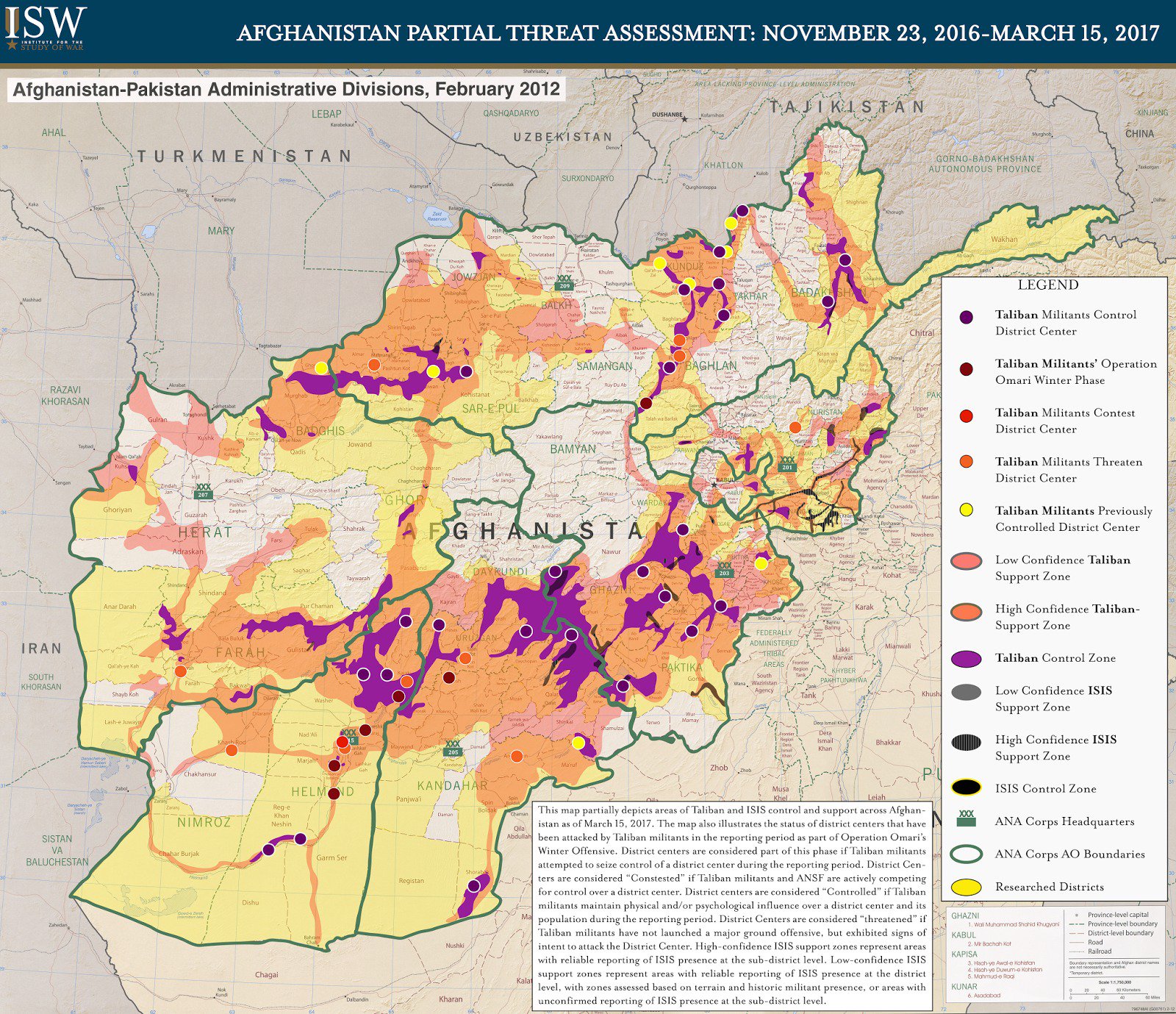 Despligue histórico de EEUU y bajas desde 2001: 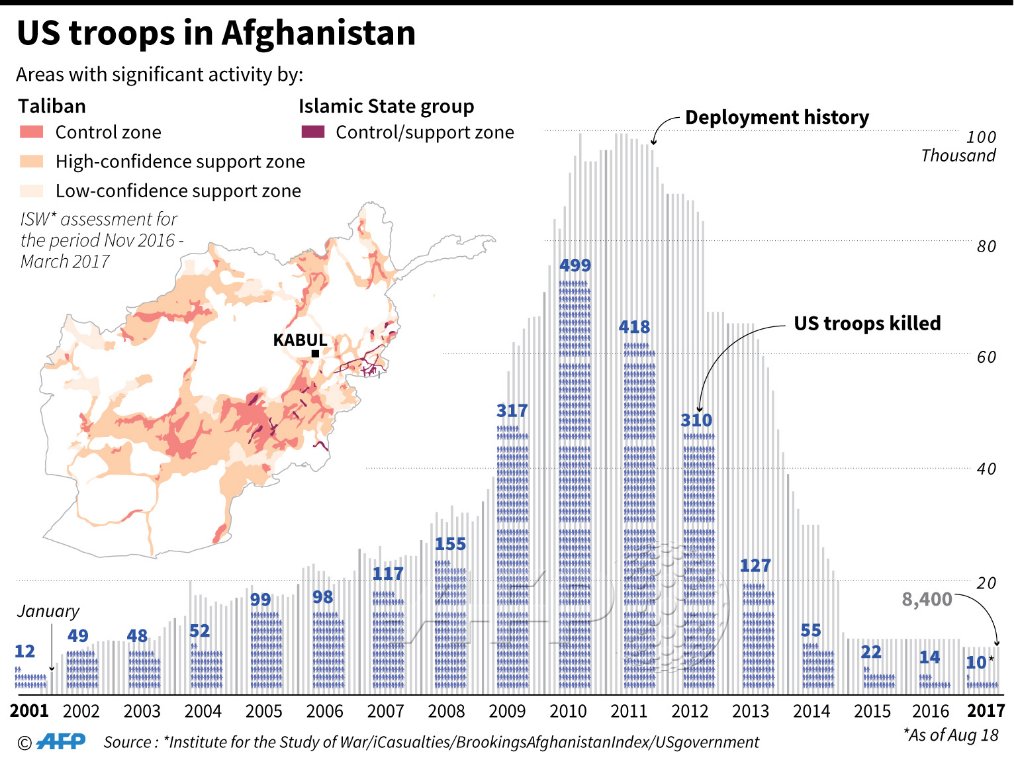  https://elordenmundial.com/2016/12/2...del-hindukush/ CRONOLOGÍA de la OPERACIÓN "LIBERTAD DURADERA" 2001-2014 (CNN)Here's a look at Operation Enduring Freedom, which began on October 7, 2001 with allied air strikes on Taliban and al Qaeda targets. The United States linked the September 11, 2001 terrorist attacks to al Qaeda, a group that operated under the Taliban regime's protection in Afghanistan. The operation was launched to stop the Taliban from providing a safe haven to al Qaeda and to stop al Qaeda's use of Afghanistan as a base of operations for terrorist activities. Timeline:
October 7, 2001 - Operation Enduring Freedom begins. President George W. Bush announces that US and British forces have begun airstrikes on Taliban and al Qaeda targets in Afghanistan. Airstrikes continue for five days. October 14, 2001 - The Taliban offers to discuss giving Osama bin Laden to a third country for trial if the United States provides evidence of bin Laden's involvement in the 9-11 attacks. The White House rejects the offer. October 19, 2001 - The Pentagon reports that US forces have searched a compound used by Taliban leader Mullah Mohammed Omar. This is the first acknowledged ground action of OEF. October 26, 2001 - British Armed Forces Minister Adam Ingram tells the House of Commons that Britain is deploying a force of 4,200 military personnel to Afghanistan. November 1, 2001 - Turkey announces it will deploy troops to Afghanistan. Australia and Canada also agree to send forces. November 5, 2001 - US Defense Secretary Donald Rumsfeld announces that the United States has more than doubled the number of its troops based in Afghanistan. November 6, 2001 - German Chancellor Gerhard Schroeder offers up to 3,900 troops for the effort. November 7, 2001 - Italy says it will provide 2,700 troops. November 9, 2001 - The Netherlands announces that they are prepared to send up to 1,400 troops to Afghanistan. November 13, 2001 - US airstrikes and ground attacks by the anti-Taliban Afghan Northern Alliance lead to the fall of Kabul. November 16, 2001 - French troops deploy for Afghanistan. November 20, 2001 - The bodies of four journalists missing in Afghanistan are recovered. The journalists were on the road between Jalalabad and Kabul when their convoy was attacked. November 22, 2001 - Poland agrees to contribute up to 300 soldiers to OEF. December 2-5, 2001 - The United Nations hosts the Bonn Conference in Germany. The resulting Bonn Agreement creates an Afghan Interim Authority and outlines a process for creating a new constitution and choosing a new government. December 7, 2001 - The Taliban loses its last major stronghold as the city of Kandahar falls and opposition forces enter. December 20, 2001 - The United Nations authorizes the International Security Assistance Force (ISAF) to provide security support to the Afghans. The United Kingdom agrees to lead the force initially. December 22, 2001 - Hamid Karzai is sworn in as head of an interim power-sharing government. January 23, 2002 - Wall Street Journal reporter Daniel Pearl is abducted in Karachi, Pakistan, by the National Movement for the Restoration of Pakistani Sovereignty, which claims the kidnapping is in retaliation for the detention of Pakistanis at Guantanamo. January 27, 2002 - Media organizations receive the first email from Pearl's captors, which includes photos of reporter Daniel Pearl handcuffed with a gun to his head. February 21, 2002 - FBI and Pakistani officials announce they have received a videotape that confirms Pearl has been killed. March 25, 2002 - Defense Secretary Donald H. Rumsfeld announces that there are plans under way for US and coalition forces to help train and create an Afghan national army. June 13, 2002 - Hamid Karzai is elected to a two-year presidential term by the grand council, a gathering of Afghanistan's tribal leaders. August 9, 2003 - NATO assumes responsibility for the ISAF mission. January 2004 - Afghanistan passes a new constitution by consensus. October 9, 2004 - Afghanistan's first direct democratic election is held. December 7, 2004 - Hamid Karzai is sworn in as the first democratically elected president of Afghanistan. September 18, 2005 - The first parliamentary and provincial elections are held in more than three decades. March 1, 2006 - President Bush makes his first visit to Afghanistan, and meets with President Hamid Karzai. February 27, 2007 - A suicide bomber blows up a checkpoint at Bagram Air Base, killing more than 20. Taliban insurgents claim Vice President Dick Cheney was the target of the attack. February 15, 2007 - President Bush calls on NATO to increase troops in Afghanistan. There are already about 50,000 US and NATO troops there. May 11, 2007 - The Taliban's top military commander, Mullah Dadullah, is killed in a US-led coalition operation. July 19, 2008 - Democratic presidential nominee Barack Obama makes his first visit to Afghanistan. December 15, 2008 - President Bush makes a surprise visit to Afghanistan. It is his second and last visit as president. February 17, 2009 - President Obama approves a troop increase of 17,000 for Afghanistan. There are currently about 38,000 US troops serving in Afghanistan. June 30, 2009 - US soldier Sgt. Bowe R. Bergdahl is taken hostage by the Taliban. He is released five years later in 2014. August 20, 2009 - Afghanistan holds its second election. Voting fraud allegations lead to the scheduling of a presidential runoff vote on November 7. October 31, 2009 - A runoff election is canceled when Foreign Minister Abdullah Abdullah drops out, leaving Karzai as the only candidate and winner by default. November 19, 2009 - Hamid Karzai is sworn in for a second term as president. December 1, 2009 - President Obama announces the deployment in 2010 of 30,000 additional US troops. This new deployment will bring the US total to almost 100,000 troops, in addition to 40,000 NATO troops. January 2010 - Representatives from over 60 nations meet in London for the International Conference on Afghanistan, pledging to support the development of the Afghan National Security Forces. March 28, 2010 - President Obama makes his first visit to Afghanistan as president. August 1, 2010 - The Netherlands becomes the first NATO member to pull combat troops out of Afghanistan. August 5, 2010 - Ten aid workers are killed by gunmen in Badakhshan, Afghanistan. Among the dead are six Americans, two Afghans, a Briton and a German. September 18, 2010 - Parliamentary elections are held. Results are delayed following allegations of fraud. December 3, 2010 - President Obama visits for the third time, the second as president. May 2, 2011 - In the early morning hours, a small group of US Forces, including Navy Seals, raid a compound in Abbottabad, Pakistan. In the ensuing firefight, al Qaeda leader Osama bin Laden is killed. DNA samples are taken to confirm his identity, then his body is buried at sea. June 22, 2011 - President Obama announces that all of the 33,000 additional US forces deployed to Afghanistan in December 2009 will return home within the next 15 months. He also announces that US combat operations in Afghanistan will end by 2014. July 13, 2011 - The first batch of departing US soldiers leaves Afghanistan. About 650 US soldiers leave the northeastern province of Parwan. August 6, 2011 - Insurgents shoot down a helicopter in central Afghanistan, killing 30 US coalition members, seven Afghan troops and a civilian interpreter. August 10, 2011 - NATO announces that Coalition forces in Afghanistan have killed Mullah Mohibullah, the Taliban leader and insurgent responsible for the downing of the helicopter that left 38 US and Afghan personnel dead. August 2011 - August becomes the deadliest month for US forces in Afghanistan since the conflict began, with 71 US casualties. September 10, 2011 - Two Afghan civilians are killed and 77 US troops and 25 Afghan workers are wounded when a Taliban suicide bomber detonates a large vehicle-borne improvised explosive device at the entrance of Combat Outpost Sayed Abad, an ISAF base in Afghanistan's Wardak province. September 13, 2011 - Taliban militants open fire near the US Embassy and NATO's International Security Assistance Force headquarters after they storm into a nearby abandoned building. Three police officers and one civilian are killed and security forces kill six militants. Taliban spokesman Zabiullah Mujahid tells CNN their target is the US Embassy, governmental organizations and other foreign organizations. February 1, 2012 - Defense Secretary Leon Panetta announces that the US hopes to end its combat mission in Afghanistan in 2013, transitioning primarily to a training role. February 21, 2012 - Violent protests break out in Afghanistan over reports that Qurans were burned at a US military base. A military official says the Qurans were removed from a detainee center library at Bagram Airfield because they had "extremist inscriptions" on them. As of March 2, the unrest has left at least 41 people dead, including six US soldiers, and hundreds wounded. March 11, 2012 - Staff Sgt. Robert Bales, an American soldier based at Camp Belambay, Afghanistan, goes on a house-to-house shooting spree in two villages in Kandahar province, killing 16 Afghan civilians. In 2013, he is sentenced to life in prison. April 8, 2012 - The US and Afghanistan sign a landmark deal that gives Afghan authorities an effective veto over special operations night raids. The deal prevents NATO's ISAF from conducting raids without the permission of Afghan officials. April 18, 2012 - The Los Angeles Times releases pictures believed to have been taken in 2010 of US 82nd Airborne Division paratroopers posing with the body parts of dead insurgents in Afghanistan. May 2, 2012 - President Obama marks the first anniversary of the death of Osama bin Laden with an unannounced trip to Afghanistan. According to the White House, his speech is the first TV address to the nation from a war zone on foreign soil. Obama and Afghan President Hamid Karzai also sign a strategic partnership agreement for 10 years of US support of Afghanistan after the 2014 troop withdrawal. June 9, 2012 - French President Francois Hollande announces his plan to withdraw combat forces by year's end will start next month. September 1, 2012 - Two suicide bombers strike a joint US-Afghan military base, killing 13 people and injuring 78 others. One bomber attacks the base on foot and another one detonates a truck. No international coalition service members are killed in the attack, but two are wounded. The Taliban claim responsibility for the attack. September 2, 2012 - US Special Operations Forces temporarily suspends training of some 1,000 Afghan local police recruits while they double-check the background of the current police force, following a rise in insider attacks against NATO troops by Afghan forces. September 14, 2012 - Fifteen insurgents wearing US Army uniforms attack Camp Bastion, a US and British military complex. Fourteen insurgents and two US Marines are killed, nine others are wounded. September 20, 2012 - US military officials report that the surge of US forces in Afghanistan has ended and the last several hundred surge troops have left the country. December 2012 - France pulls its last troops engaged directly in combat out of Afghanistan. The remaining French troops, about 1,500, will remain in Afghanistan for approximately six months to remove equipment and to help train Afghan forces. June 18, 2013 - Afghan National Security Forces formally take over combat operations. March 12, 2014 - A flag-lowering ceremony is held in Kabul to mark the end of Canada's military mission in Afghanistan. May 27, 2014 - President Obama announces that the United States combat mission in Afghanistan will end in December 2014. September 30, 2014 - The United States and Afghanistan sign a joint security agreement that will allow US troops to stay in Afghanistan beyond the previous December deadline to withdraw. October 26, 2014 - The United Kingdom formally ends its combat mission in Afghanistan with a flag-lowering ceremony in Helmand province. December 28, 2014 - After 13 years, the United States and NATO end their combat mission with Afghanistan. In an official ceremony, the commander of the International Security Assistance Force officially marks the end of coalition combat in Afghanistan by rolling up the ISAF flag. Aportes de @Sandro Munari Buenas, @Fisn0.
Mira a ver si te parece interesante poner esto en el OP. http://e-archivo.uc3m.es/bitstream/h...=1&isAllowed=y Se trata de un monográfico sobre el Conflicto de Afganistán de la Escuela de Guerra del Ejército y el Instituto de Estudios Internacionales Francisco de Vitoria, de la Universidad Carlos III. Tiene algunos años, pues es de 2009, pero por otro lado es muy completo, y aborda el conflicto desde todos los frentes (político, étnico, derecho internacional, etc...), remontándose al Gran Juego entre el Imperio Ruso y el Británico. Para gente que quiere aproximarse a enteder el conflicto, me parece casi de obligada lectura, para tener cierta base.  El Instituto Español de Estudios Estratégicos también tiene una rica documentación al respecto, como por ejemplo: Acción exterior de España en Afganistán: Lecciones aprendidas Afganistán: Fortalezas y debilidades de una transición en marcha La importancia de los corredores terrestres: El caso de Afganistán La degradación de la situación en Afganistán Si interesan iré poniendo más. Sigue elevándose la tensión en la Península de Corea Sigue elevándose la tensión en la Península de Corea VOL. II La Guerra Fría 2.0: Rusia y la OTAN La guerra de Afganistán: 2001 hasta la actualidad FLANCO SUR: El Norte de África, el Sahel y el Cuerno de África |
Editado: 03-mar-2021 00:50 -
ForoCoches: Miembro
23-ago-2017 20:08
#2
|
Los mitos de la yihad afgana Por Jesús M. Pérez http://elmed.io/los-mitos-de-la-yihad-afgana/  El reciente ataque estadounidense con una bomba tipo MOAB en Afganistán contra un complejo de cuevas que servía de base para un grupo local del Estado Islámico generó un impacto enorme en los medios de comunicación y las redes sociales. Definitivamente, si Donald Trump pretendía dar un golpe mediático, lo consiguió con pleno éxito, abriendo los noticieros en lugares como España y Uruguay. Personalmente, asistí en las redes sociales a un fenómeno curioso. El uso de la MOAB contra unas cuevas en las montañas de Afganistán generó más respuestas emocionales que cualquier bombardeo de núcleos urbanos realizado por la aviación rusa en Siria o la saudí en el Yemen. Ni siquiera el reciente uso por parte del régimen sirio de armas químicas contra su propia población generó una respuesta así. Más bien, encontró escepticismo y dudas que se volvieron agitación tras el ataque norteamericano con misiles de crucero contra la base aérea de Shayrat. Entonces, aparecieron en internet carteles del “No a la guerra” para condenar un ataque puntual contra una instalación militar de unas fuerzas armadas que han golpeado duramente a su propia población. Cualquiera diría que la diferencia de respuestas nos puede dar una idea de cuál es el estímulo que genera esos comentarios airados en Facebook y esos tuits indignados. Y en esa ola de agitación social ante el uso de la MOAB aparecieron comentarios de una ironía típicamente hipster y millenial que hacían referencia a que Estados Unidos combatía a los mismos grupos yihadistas que había creado. Efectivamente, volvíamos una vez más a escuchar los bulos de que, en Afganistán, Estados Unidos creó Al Qaeda, entrenó a Osama ben Laden y armó a los talibán hasta que se volvieron en su contra. Bulos zombies que siguen circulando gracias a la ignorancia y al deseo ferviente de sentir indignación moral contra Estados Unidos. La guerra en Afganistán comenzó cuando un Gobierno comunista emprendió reformas modernizadoras que soliviantaron a la población rural, religiosa y conservadora. Entre esas reformas estaba una que afectó a un asunto que revuelve las entrañas de cualquier campesino del planeta: la propiedad de la tierra. Los comunistas afganos procedieron a su colectivización. Las protestas fueron reprimidas y generaron un efecto de acción-reacción que llevó a más disturbios, masacres, el asesinato de asesores soviéticos y la deserciones masivas de unidades militares que se unieron a la población en rebeldía contra el Gobierno de Kabul, en lo que era ya practicamente una guerra civil.  Afganistán logró su independencia para cumplir la función de Estado tapón que impidiera el choque directo de los imperios británico y zarista durante el Gran Juego de Asia. Su población incluye grupos étnicos que encontramos en las repúblicas de Asia Central y Pakistán. Así que la revuelta afgana generó ondas de choque en sus países vecinos. La URSS temió que la crisis afgana se extendiera hacia las repúblicas soviéticas con población musulmana de Tayikistán y Uzbekistán. Pakistán recibió oleadas de refugiados pastunes, grupo étnico que siempre consideró la frontera una línea abstracta. Estados Unidos y Pakistán decidieron echar gasolina al fuego afgano con la esperanza de perjudicar a la Unión Soviética. El presidente Carter autorizó la ayuda a los rebeldes afganos en el verano de 1979. La URSS decidió descabezar al irresponsable Gobierno afgano y colocar uno más confiable mediante una invasión militar. Una vez ocupado Afganistán, la URSS quedó atrapada en un conflicto del que tardó casi un década en salir. El esfuerzo estadounidense para apoyar a la insurgencia afgana tuvo una peculiaridad. Se externalizó a Pakistán. La aún reciente experiencia de la guerra de Vietnam alimentaba las ganas de venganza. Al fin y al cabo, Saigón había caído sólo cuatro años antes de la invasión soviética de Afganistán. Pero también generó el temor en Washington a otro fiasco asiático, y el presidente Carter no quería que la CIA se manchara las manos. El programa se amplió durante el Gobierno Reagan y contó con la financiación adicional de Arabia Saudita. Ceder a Pakistán el control directo del programa de apoyo a los rebeldes afganos tuvo un inconveniente que la CIA no comprendió en aquel momento. El régimen pakistaní del general Zia ul Haq tenía una agenda propia y particular. En primer lugar, había llegado al poder mediante un golpe de Estado y su régimen carecía de base social. Así que intentó construirla dando protagonismo a las organizaciones islamistas. Por ejemplo, puso en manos de las organizaciones asistenciales islamistas la atención a los refugiados afganos, que pasaron a ser educados en escuelas religiosas profundamente conservadoras. En segundo lugar, a Pakistán le interesaba obtener mayor profundidad estratégica. Esto es, frente al enorme tamaño de la India, Pakistán quería asegurarse una enorme retaguardia en las montañas afganas. Así que el todopoderoso servicio secreto pakistaní, el ISI, favoreció de entre los rebeldes afganos a los grupos islamistas y a los grupos pastunes. La guerra afgana contra el invasor soviético se convirtió en una guerra religiosa. Los rebeldes afganos fueron así conocidos como los muyahidín, “los que hacen la yihad”. Se reclutó a voluntarios para la yihad afgana en los países árabes, cuyos regímenes estuvieron encantados de deshacerse de sus islamistas para que fueran a morir en las montañas de Afganistán. Mientras, ONG y organizaciones caritativas musulmanas recogían dinero para la causa y atendían a la población afgana que había huido del país. La ciudad de Peshawar se convirtió en la capital de los afganos refugiados en Pakistán. Por allí pasaron espías, aventureros, periodistas, oportunistas y activistas de todo tipo. Entre los personajes que aparecieron en Peshawar estaban el médico egipcio Aymán al Zawahiri y el ricachón saudí Osama ben Laden. Al principio se dedicaron a labores de retaguardia, ayudando a los refugiados y distribuyendo la ayuda recibida. A finales de 1985 eran casi un centenar de voluntarios. Según fue cayendo bajo el influjo de Al Zawahiri, Ben Laden comenzó a pensar en participar en la lucha armada. Los voluntarios, principalmente árabes, que cruzaban la frontera para empuñar las armas en Afganistán se encontraron con que no hablaban el idioma local y que las costumbres de los pastunes les resultaban chocantes. Así que Ben Laden, aprovechando que tenía los bolsillos llenos, montó su propio grupo de combatientes, fuera de la cadena de mando de los muyahidines. El flujo de voluntarios árabes aumentó de forma oportunista justo en los últimos años de la guerra, cuando ya se veía que los soviéticos y sus aliados locales controlaban cada vez menos territorio. Entre 1987 y 1989 se alcanzó una cifra estimada de entre 3.000 y 5.000 voluntarios árabes. En 1988 las fuerzas soviéticas se retiraron de Afganistán. El Gobierno comunista afgano sobrevivió hasta 1992. Entonces, los muyahidines se lanzaron a un juego de tronos que sumió el país en el caos y el desgobierno. Los voluntarios islamistas volvieron a sus países de origen. Los agentes de la CIA, también. Incluso Ben Laden, viendo el panorama, se volvió a Arabia Saudita. Todos parecieron olvidar Afganistán. En 1994 irrumpió en el panorama afgano un grupo de combatientes de etnia pastún formado por aquella generación de niños de la guerra afganos educados en las escuelas religiosas pakistaníes. Se les conoció como “los estudiantes”, los talibán. La población afgana, harta del desgobierno, dio la bienvenida al grupo, como años más tarde sucedería en Somalia con los Tribunales de la Sharía o en Siria con el Estado Islámico. Los talibán impusieron orden aplicando una justicia brutal. Y sobre todo hicieron posible el tránsito libre de norte a sur, permitiendo la conexión de Asia Central y Pakistán por carreteras donde antes había grupos armados que exigían peajes. En 1996 Kabul cayó en manos de los talibán. Detrás de su auge estuvo, cómo no, el servicio secreto pakistaní. Algunos de esos voluntarios islamistas, los árabes afganos, volvieron a sus vidas cotidianas. Otros decidieron llevar la yihad a sus países de origen. Mientras la llama de la guerra prendió en Argelia, los yihadistas fracasaron en lugares como Libia y Egipto. Los supervivientes de organizaciones derrotadas, como el Grupo Islámico Combatiente libio o la Yihad Islámica egipcia de Al Zawahiri, terminaron de vuelta en Afganistán para reunirse con Ben Laden, que había llegado allí tras enemistarse primero con las autoridades saudíes y ser expulsado de Sudán después. El 23 de febrero de 1998 lanzaron su primera declaración de guerra contra Estados Unidos y sus aliados. Hablar de Osama Ben Laden como un “terrorista entrenado por la CIA” es ignorar su posición social y su papel en la yihad afgana. Cuando nació, su padre era el plebeyo más rico de Arabia Saudita. Usó en Afganistán su experiencia laboral en las empresas de su familia (había estudiado gestión empresarial) para montar un aparato logístico de apoyo a los muyahidines, dirigió obras públicas y luego montó su propio grupo de combatientes. Aquellos contactos y experiencias le sirvieron para crear luego una organización terrorista transnacional. Los talibán, contra los que Estados Unidos entró en guerra en 2001, son un fenómeno posterior a la guerra contra los soviéticos de los años 80. Algunos muyahidines se unieron a los talibán. Otros no, fueron sus enemigos mortales. La yihad global es históricamente contingente. Pudo haber nacido en cualquier otra parte. El agotamiento del socialismo árabe dio paso al islamismo como ideología emergente en el mundo árabe de forma paralela en muchos sitios a la vez. Se acumulan los libros, documentos y testimonios que permiten recorrer la historia de la yihad afgana y el papel de Estados Unidos. Si los bulos aparecen una y otra vez es porque, evidentemente, alguien sale ganando con ellos. http://elmed.io/los-mitos-de-la-yihad-afgana/ |
ForoCoches: Miembro
23-ago-2017 20:09
#3
|
Video de la llamativa MOAB usada contra el ISIS en Afganistán hace unos meses: https://twitter.com/Conflicts/status/852845487904497664 [Video Error - ID incorrecto] |
ForoCoches: Miembro
23-ago-2017 20:12
#4
|
Esta mañana ha habido un ataque suicida en la provincia de Helmand por parte de los Talibán: #Afghanistan #Helmand - Explosion reported close to police headquarters in Lashkargah city. Early reports state it was suicide bomber (Tolo) #Afghanistan #Lashkargah - Death toll rises to 7. |

Miembro mu largo
23-ago-2017 20:13
#6
|
Como decían en Rambo3 https://m.youtube.com/watch?v=4xsi-t4miTU Mousa: This is Afghanistan... Alexander the Great try to conquer this country... then Genghis Khan, then the British. Now Russia. But Afghan people fight hard, they never be defeated. Ancient enemy make prayer about these people... you wish to hear? Rambo: Um-hum. Mousa: Very good. It says, 'May God deliver us from the venom of the Cobra, teeth of the tiger, and the vengeance of the Afghan.' Understand what this means? Rambo: That you guys don't take any shit? Mousa: Yes... something like this. Profético es poco. |
ForoCoches: Miembro
23-ago-2017 20:15
#7
|
Una estrategia para evitar que Pakistán siga siendo santuario talibán http://www.elmundo.es/internacional/...2198b45b9.html  Durante varios meses los generales del ejército de Estados Unidos han intentado convencer al General en Jefe del ejército paquistaní, Qamar Javed Bajwa, de que impida que Pakistán siga siendo un santuario para los talibán afganos. También intentaron persuadirle de que, antes de que Washington anunciara su nueva política en Afganistán, era imperativo que Paquistán se uniera a ellos para evitar represalias. El ejército paquistaní, a cargo de la política exterior del país, ha negado pública y vehementemente que Pakistán esté dando cobijo a los talibán, pero funcionarios paquistaníes lo han reconocido en privado y han afirmado que están haciendo todo lo posible para deshacerse de ellos. El problema es que ni Estados Unidos, ni sus aliados internacionales y en la OTAN, y en ningún caso sus países vecinos, se creen ya las excusas de Pakistán.
"Ya no podemos callar por más tiempo ante el hecho de que Pakistán es un puerto franco para organizaciones terroristas", ha declarado Trump. "Pero esto tiene que cambiar. Y va a cambiar de manera inmediata", ha añadido. La amenaza implícita en sus palabras es que en última instancia Estados Unidos podría imponer algún tipo de sanciones a Pakistán. Los paquistaníes esperaban un rapapolvo, pero lo que realmente va a soliviantar al mando de su ejército es el objetivo expreso de Trump de "seguir desarrollando su colaboración estratégica con India", así como que haya pedido a dicho país una mayor contribución para estabilizar Afganistán. Desde el 11S, el ejército de Pakistán se ha sentido amenazado por los avances diplomáticos y económicos de India en Afganistán. La India ha proporcionado ayudas e infraestructuras valoradas en más de dos mil millones de dólares a los afganos. Por esta razón el ejército paquistaní se guarda un as en la manga en forma de militantes islamistas, no sólo talibán, sino también de otros grupos armados que combaten en la Cachemira bajo control indio. Pakistán esperaba que la muy publicitada "estrategia para el sur de Asia" de Trump incluyera, como mínimo, un esfuerzo diplomático dirigido por el presidente americano para intentar que Pakistán e India entablaran conversaciones de paz; y más concretamente, para intentar poner fin a la mutua rivalidad existente en relación a Afganistán, de manera que las fuerzas de Estados Unidos y Afganistán pudieran ponerse manos a la obra para derrotar a los talibán. Pero en su lugar, está sucediendo exactamente lo contrario. Trump quiere que India intervenga aún más en Afganistán, y está claro que a Estados Unidos no le interesan las inquietudes estratégicas de Pakistán ni su preocupación ante la presencia de la India que lo atenaza en sus dos fronteras. Más aún, en su discurso, Trump no hizo referencia alguna a Irán ni Rusia, países que, según los servicios secretos americanos, están proveyendo de armas y dinero a los talibán. Pakistán no es el único que intenta hacerse su amigo. La política exterior paquistaní de los últimos meses ha sido un desastre. Mantiene conflictos abiertos con tres de sus vecinos - India, Irán y Afganistán -, y, según veteranos diplomáticos occidentales, los santuarios talibán generan un criticismo estridente. Además, la política afgana ha contribuido a socavar la confianza entre los militares paquistaníes y su anterior primer ministro Nawaz Sharif, a quien los tribunales obligaron a dimitir el mes pasado por corrupción. Hace tiempo que Sharif buscaba un acuerdo con Afganistán, pero no puso suficiente empeño en conseguirlo. Hasta ahora sólo China ha apoyado a Pakistán, y lo volvió a hacer ayer (22 de agosto). "Creemos que la comunidad internacional debería reconocer sin fisuras el anti-terrorismo de Pakistán", afirmó Hua Chunying, portavoz del ministro de asuntos exteriores chino. Pakistán ha hecho "grandes sacrificios", añadía. Sin embargo, China no puede interpelar a toda la comunidad internacional. Pakistán ha ayudado a los talibán desde su surgimiento en 1993, principalmente como bastión frente a la influencia india. A estas alturas muchos talibán están plenamente integrados en los negocios, las propiedades y el comercio del país. Sus hijos asisten a colegios y universidades paquistaníes. Deshacerse de ellos mediante la fuerza podría provocar la represalia de los talibán afganos contra un ejército que ya lucha con los talibán paquistaníes. Por todo esto, Pakistán hace tiempo que demanda conversaciones de paz entre los talibán y el régimen de Kabul, en busca de un acuerdo político que permita a los primeros marcharse a casa. Pero Estados Unidos y la OTAN dudan - una vez más - de la sinceridad de Pakistán, y de que realmente tenga la voluntad de presionar a los talibán para que cesen sus ataques. Si la nueva agenda de Trump se activa precipitadamente, esto llevará casi con total seguridad a una seria ruptura entre Estados Unidos y Pakistán, y a una escalada de las tensiones con India y Afganistán. Así, Pakistán podría acabar aún más aislado, y el sur de Asia convertirse en un hervidero de hostilidades en el cual los dos países más grandes cuentan con armamento nuclear. La administración Trump ha mostrado pocas dotes para la diplomacia, y lo que Paquistán necesita para cambiar su política es claramente la táctica del palo y la zanahoria. Invitar a la India a que se convierta en el socio de Trump en el sur de Asia solo avivaría el avispero, y haría que el ejército paquistaní se negara a realizar cualquier presión sobre los talibán. |
Editado: 23-ago-2017 20:21 -

ForoCoches: Miembro
23-ago-2017 20:25
#9
AFGHANISTAN, PAKISTAN, AND THE LIMITS OF U.S. INFLUENCE https://warontherocks.com/2017/08/af...u-s-influence/ President Donald Trump has announced the results of his “comprehensive review” of U.S. strategic options in Afghanistan and South Asia and – as many have already noted – they are uninspiring. Sixteen years of war leads to bouts of soul-searching, but it seems we aren’t obliged to turn up any new thinking in the search.
Any Afghanistan policy review is necessarily a Pakistan policy review. This is simply because, as many experts and even the president has realized, Afghanistan is not “solvable” absent some dramatic change in Pakistani behavior. Jeff Smith, for example, concludes that unless this current review “starts and ends with a decisive change in our Pakistan policy, it will produce the same outcome as every Afghan strategy before it.” The logic that a change of Pakistani strategy is a necessary condition for any prospect of Afghan success is fairly simple. A 2010 study by the RAND Corporation examined 30 counter-insurgency campaigns and found none were successful so long as there was significant cross-border insurgent support. And, for years now, the U.S. government has concluded that Pakistan provides a safe haven for, among others, the Afghan Taliban and the Haqqani network as they engage in violent operations in Afghanistan. Some believe that in addition to providing operational space for insurgent groups to train, fundraise, and escape pressure, Pakistan’s intelligence agencies may directly provide weapons and money to these groups. This basic linkage between Pakistani behavior and Afghan outcomes did not suddenly dawn on the Washington policy community this year. This is at least the third U.S. attempt to induce Pakistani policy change. The George W. Bush administration tried strategic love and affection to overcome deep-felt Pakistani insecurities exacerbated by its episodic “abandonment” by the United States. They attempted to convince Pakistan that this time the partnership would endure, and from this foundation permit Pakistan to reorient its grand strategy away from confrontation with India and toward normalcy. That failed. Initially, the Obama administration approach could be characterized as more of the same. It supported a massive, multiyear aid program in 2009. But following the troubles of 2011, most notably the raid on Abbottabad that killed Osama bin Laden, the relationship never fully recovered. Whitney Kassel and Philip Reiner, who both worked on Pakistan policy for the Obama administration, conclude in a recent article that U.S. strategy ultimately devolved into “a quiet tolerance of the country’s double dealing.” Now we have Trump’s try for a different outcome. Prior to the strategic review, Trump appears to have thought very little about Pakistan, as indicated by his pre-inauguration telephone call with Pakistan’s now former prime minister. Trump’s ideological malleability makes him unpredictable, but he does appear to have a “base impulse” that the United States is being taken advantage of by international actors and consequently the world is laughing at us — something that he wants to rectify (or at least be seen as doing so). How this instinct responds to Pakistani behavior has been the great question of America’s South Asia policy, simply because Pakistan has been taking advantage of the United States. To remove the moral connotations of that statement, Pakistan has been collecting geopolitical rents. The question is whether there is a better deal to be had. On Monday, Trump suggested he would find one: We have been paying Pakistan billions and billions of dollars at the same time they are housing the very terrorists that we are fighting. But that will have to change, and that will change immediately. The president is not wrong on the history, but that is precisely where the limits of U.S. influence become evident. The United States has provided in excess of $33 billion to Pakistan since 9/11. In exchange, Washington receives a schizophrenic partner on counter-terrorism, one that is intermittently aggressive in confronting groups targeting the Pakistani state (most notably the Tehrek-e-Taliban Pakistan), helpful against groups focused on Western targets (such as al-Qaeda or the Islamic State), half-hearted against groups that primarily target Pakistani Shia and that have occasionally been involved in attacks against outsiders (such as Lashkar-e-Jhangvi), unwilling to act against Afghanistan-focused groups (such as the Afghan Taliban and Haqqani network), and supportive of groups that target India (such as the Lashkar e-Tayyiba and Jaish-e-Mohammad). That partnership likely includes considerable Pakistani cooperation with Western intelligence agencies examining threats from citizens or visitors of Pakistani origin, though the full extent is unclear in the open domain. The counter-terrorism partnership’s most publicized aspect is, ironically, the one that ought to be the most secret — the U.S. “covert” program to target terrorists in Pakistan using armed drones. Pakistan has publicly opposed the strikes as violations of Pakistani sovereignty that generate excessive civilian casualties, but it appears the vast majority of the drone campaign occurred with the explicit or tacit consent of the Pakistan military, including permitting U.S. operations from Shamsi air base near Quetta for a decade from 2001 to 2011. Pakistan is also critical for the U.S. mission in land-locked Afghanistan, even as its behavior undermines U.S. objectives there. The troubled state of U.S.-Russia relations following the latter’s invasion of Ukraine resulted in Russia shutting down the so-called Northern Distribution Network that re-supplied Afghanistan through the Central Asian republics. U.S.-Iran relations have become only more troubled since the beginning of Trump’s presidency, and appear likely to worsen further still. The United States has begun using Turkmenistan for “humanitarian cargo,” a euphemism that in this case likely means “nonlethal” supplies to the U.S. mission in Afghanistan. Thus, the United States presence in Afghanistan depends — and will depend for the foreseeable future — on Pakistan, which permits U.S. ground and air lines of communication. Absent unexpected, major improvements in U.S.-Russia or U.S.-Iran relations, or a U.S. withdrawal from Afghanistan, this dependence on Pakistan cannot be alleviated. “No matter how great President Donald Trump makes America, he cannot win the war on geography,” observes Afghan expert and former U.S. official Barnett Rubin. The U.S. presence in Afghanistan is primarily about preventing terrorist groups operating there, but there is some reporting that suggests elements of the U.S. government are wary of losing basing in Afghanistan that is useful to monitor Pakistani terrorist groups and Pakistan’s nuclear weapons development efforts. After the United States was evicted from Shamsi, it reportedly maintained the ability to operate drones from airbases in Jalalabad, Bagram, and Kandahar. U.S. fears over Pakistani nuclear stewardship have oscillated over time, but such concerns have repeatedly appeared “at the top” of U.S. national security worries, and Trump reemphasized them on Monday night. Academic, former U.S. official, and War on the Rocks senior editor Stephen Tankel identifies “keeping militants from getting their hands on nuclear material” as a vital security interest in Pakistan. This interest is comingled with another, “critical interest” in “preventing Indo-Pakistani nuclear escalation,” since Tankel assesses “weapons are most likely to fall into terrorists’ hands if forward-deployed during a conflict with India.” Pakistan likely possesses more than 100 nuclear weapons today and might possess fissile material for up to 200 or 300 nuclear weapons. These U.S. interests — collecting intelligence on potential radicals in the Pakistani diaspora in the West, operating drones over Pakistani territory to engage in targeted assassinations of dangerous terrorists, resupplying the U.S. military presence in Afghanistan, and preventing the loss of control of Pakistan nuclear weapons — are substantially more important than the list of U.S. grievances against Pakistan. Pakistani support of groups that have targeted U.S. forces and its support of anti-India groups that have periodically targeted U.S. citizens may well be a moral travesty, but geopolitically it may be less costly than losing Pakistan’s cooperation in other areas. To be sure, the pro and con columns are not neatly separated. Quietly accepting Pakistani support of terrorist groups may ultimately endanger the foremost U.S. security interest in Pakistan: preventing the loss of a nuclear weapon or other sensitive nuclear technology to radical non-state groups – a fear Trump raised in his speech. Violent extremist groups are ultimately a cancer on Pakistani society that pose a mortal danger to it. Already, the military is hesitant to confront anti-Afghan and anti-India groups in part because it seeks to triage the threats to Pakistani society, prioritizing those militants that actively target the Pakistani state while nudging remaining radicals to focus their zealous energies elsewhere. However, a delineation of the entirety of U.S. interests suggests escalating coercive pressures against Pakistan is just as likely to endanger U.S. goals as further them. The most prominent reason given for a punitive U.S. Pakistan strategy is Pakistan’s behavior in Afghanistan, but there, as Rubin correctly stresses, “the United States risks provoking a blockade of its own forces.” Thus, in any game of brinksmanship, Pakistan is not bluffing — it has a good hand! Moreover, the Trump administration’s hand in 2017 is not the same as the Bush administration’s hand in 2001, when the Bush administration successfully demanded Pakistani abandonment of the Taliban government after 9/11 and support for U.S. operations in Afghanistan. Pakistan has alternative partners, namely China and Saudi Arabia, that can pick up some of the slack created by any U.S. funding cuts, and has been cultivating improved ties with Russia. China is expected to invest more than $50 billion as part of the China-Pakistan Economic Corridor (CPEC), though importantly the vast majority of this amount is in the form of loans rather than grant aid. Even so, China is aware of Pakistan’s credit risks, and would not make such enormous loans were it not prepared to defer or eliminate some of the debt in the event of a future Pakistan economic crisis. The size of CPEC loans also gives China a substantial stake in preventing the emergence of any multilateral containment regime that would cause meaningful harm to Pakistan’s economy. To date, U.S. coercion has largely entailed modestly decreasing reimbursements it has paid for Pakistani military operations and limiting the types of defense equipment it transfers to Pakistan. Periodic calls to end Pakistan’s status as a major non-NATO ally would have modest symbolic meaning and nearly no substantive implications. In fairness, such levers can be pulled with little risk of serious blowback and just as little risk of serious results. It may well be appropriate to “at least stop sponsoring” Pakistan’s “noxious behaviors,” but such a case is built on fiscal prudence and normative concerns, rather than any great likelihood of altering Pakistani behavior. In fact, even the most vocal advocate of a more coercive strategy against Pakistan, C. Christine Fair, concludes, “it is unlikely that the United States can offer Pakistan any incentive that would be so valuable to Pakistan and its security interests that the [Pakistan] army would abandon” its current grand strategy. The United States has a repertoire of coercive tools beyond just the cessation of foreign aid or restrictions on defense sales, including targeted sanctions of individuals in Pakistan’s government associated with terror groups or working to cease World Bank and International Monetary Fund financing. Each step along this escalatory path, though, encourages Pakistan to counter with coercion of its own: (1) restricting U.S. use of ground and air lines of communication through Pakistan, (2) preventing the operation of (non-stealthy) U.S. drones over Pakistani territory, (3) ignoring U.S. requests for intelligence regarding suspected terrorists in the West, and (4) permitting even greater freedom of maneuver to anti-India or anti-Afghan terrorist groups. In the deeper recesses of Pakistan’s coercive toolkit, Pakistan can give China access to U.S.-origin defense hardware, offer extended deterrence guarantees to Saudi Arabia or resume the transfer of ballistic missile or nuclear weapons technology, an illicit commerce it last engaged in during the previous era of U.S. sanctions in the 1990s. Any brinksmanship initiated now by the United States would occur during a period of profound political weakness in Islamabad following the judicial dismissal of Prime Minister Nawaz Sharif. This state of affairs is not exogenous: It likely conforms to the Pakistan Army’s preferences. But until the next national elections in 2018, and quite likely even after them, civilian and military leaders will be jockeying for domestic authority, creating strong disincentives for international concessions. All of these factors conspire against U.S. pressure resulting in real change in Pakistan’s national security policy. Lisa Curtis, the White House senior director for South Asia, recently told a New Delhi audience that there was no interest in the Trump administration to accept the status quo with Pakistan. But the reality is there are profound dangers in clumsy attempts to force Pakistan to alter its current policy, however unpalatable. Those advocating such a course of action are obligated to delineate what risks they are willing to take. Otherwise, they are in danger of replicating the inept rhetoric of the Trump administration’s Qatar, North Korea, and Iran policies or, even worse, transforming Pakistan into a true rogue state. For those who assert Pakistan’s current actions already merit such a rogue moniker, they ignore how much worse it can get. Pakistan is a frenemy — and as unpleasant as Pakistani behavior is, it could be much worse. |
ForoCoches: Miembro
23-ago-2017 20:33
#10
|
Trump desvela la nueva estrategia de Estados Unidos en Afganistán: "No diré cuándo vamos a atacar, pero atacaremos" http://www.elmundo.es/internacional/...1638b466d.html El presidente Donald Trump dio a conocer este lunes la nueva estrategia de EEUU en Afganistán y Asia del Sur como había anunciado la Casa Blanca este domingo. Un nuevo enfoque que supone un cambio "dramático", según advirtió desde la base militar de Fort Myer (Virginia) en su primer mensaje a la nación desde la toma de posesión en enero.
Su "instinto original" era retirar las tropas -como venía pidiendo desde 2011- , pero finalmente no lo ha seguido. El nuevo enfoque estratégico se asienta sobre la premisa de que no va a anunciar previamente lo que las fuerzas armadas van a hacer. "Las condiciones en el terreno guiarán nuestra acciones", señaló en su discurso ante decenas de soldados y un nutrido grupo de miembros de su gabinete. "No hablaremos sobre el número de tropas o nuestros planes sobre futuras acciones militares", subrayó Trump para explicar uno de los pilares de la nueva estrategia. Desde el pasado mes de junio, el máximo responsable de Defensa contaba con la autorización del presidente para enviar hasta 3.900 soldados a Afganistán. Una cifra que ha quedado en el aire. El presidente insistió en que es contraproducente dar números o anunciar cuándo se va a atacar. "Los enemigos de EEUU no deben saber nuestros planes", apuntó antes de señalar que no dirá "cuándo vamos a atacar, pero atacaremos". Tras el anuncio del presidente estadounidense, los talibán han respondido diciendo que Afganistán se convertirá en el "cementerio" de Estados Unidos. "Si los estadounidenses no retiran sus fuerzas de Afganistán, no está lejos (el día en que) Afganistán se convertirá en el cementerio del siglo XXI del imperio estadounidense", indicó en un comunicado remitido a Efe el portavoz de los talibán, Zabihullah Mujahid. El portavoz talibán aseguró que los insurgentes continuarán en su lucha hasta que EEUU abandone el país. "Mientras que un soldado de EEUU permanezca en el país (...) continuaremos con nuestra yihad contra ellos con la moral fuerte, con plena voluntad y más sobriedad", detalló el líder talibán. |
Editado: 23-ago-2017 20:41 -

ForoCoches: Miembro
23-ago-2017 21:53
#11
| Si los EE:UU no hubieran metidos sus narices en el conflicto afgano ahora no estaríamos así. De estos barros, estos lodos. |



*AutoBan Spam/Flood/Troll*
23-ago-2017 22:19
#15
|
Tinglado espantoso Toma mapa étnico  ¿La solución? Miren mapa de pakistán y miren el nombre de las etnias  Balochis y Pastunes los unes a Pakistán. Turcomanos a turkmenistán, uzbekos a uzbekistán, tayikos a tayikistán, etc. Cada etnia en su nación Repartes la tierra y las personas hacia cerca de las respectivas fronteras de forma proporcional y fin. |
Editado: 23-ago-2017 22:27 -

ForoCoches: Miembro
23-ago-2017 22:38
#18
|
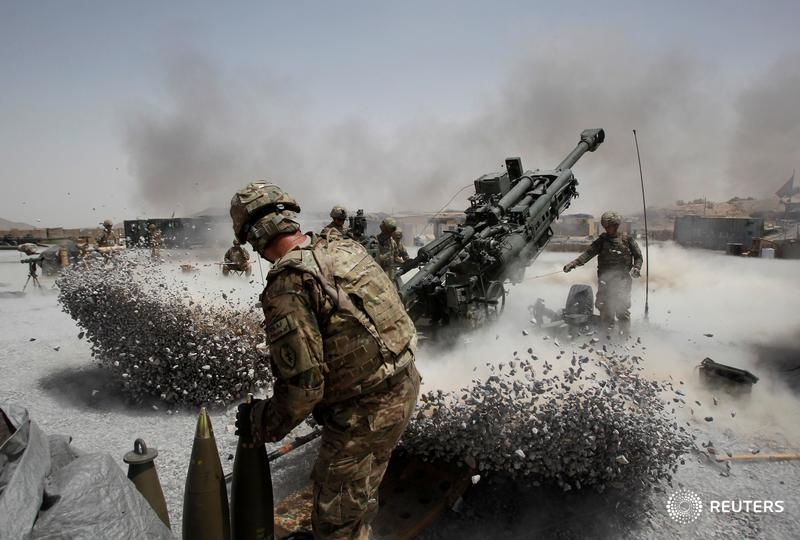
Para aquellos que no comprendan lo que va a hacer la Administración Trump respecto al desarollo del conflicto del Afganistán, lo explico. Se va a aumentar el número de tropas, pero afirma que no va a decir ni cuándo ni cuantas. Ha confirmado que su intención inicial era la retirada definitiva pero que no quiere crear un vacío en el país. Asimismo afirma que su propósito en el país es simplemente hacer frente al terrorismo, no construir una democracia o un Estado viable en Afganistán y ha afirmado que está estrategia no es un cheque en blanco al gobierno afgano, que debe ser el principal actor en el país. Asimismo ha cargado duramente contra Pakistán y apuesta por la cooperación con la India en el país. Por último afirma que va a pedir a los aliados y países de la OTAN que envíen tropas adicionales y aporten más fondos. |
ForoCoches: Miembro
23-ago-2017 22:39
#19
| Según The Wall Street Journal EEUU tiene desplegados actualmente en el país 12.000 militares, una cifra superior a los 8.500 que es de la que se informa oficialmente. |


ForoCoches: Miembro
23-ago-2017 22:43
#22
|
Estamos frente a una guerra larga y difícil como otras tantas que ha habido en la Historia de nuestro mundo. No estamos en Afganistán solamente para ayudar a los afganos que no quieren vivir bajo un régimen talibán sino para evitar ataques terroristas contra Europa. A los terroristas se les aniquila sin piedad, en cualquier país. Una retirada de Afganistán supondría una victoria para los talibanes, el país entraría en un mayor caos, atentados y crímenes serían el pan de cada día, civiles e inocentes perseguidos por los yihadistas. Hay una guerra mundial contra el terrorismo y tenemos que actuar como tal, tenemos que luchar contra ellos donde estén, luchar y vencer a los terroristas. |
Editado: 23-ago-2017 22:51 -
ForoCoches: Miembro
23-ago-2017 22:59
#23
|
El error no fue invadir Afganistán, el error fue el invadir Irak en 2003. Sino se hubiese invadido Irak en 2003 y se hubiera proseguido con toda la logística sin estar en Irak, la situación hoy sería distinta. Y la situación también sería distinta si la Administración Obama no hubiera hecho una política exterior tan nefasta. |

ForoCoches: Miembro
23-ago-2017 23:02
#24
| Anexionarse Pakistan? Pues no les va a costar poco eso... Y lo de Nepal ect con los chinos me da que tampoco. |
ForoCoches: Miembro
23-ago-2017 23:03
#25
| Mas bien crear una zona de influencia comercial y trabajar con Pakistán. |
ForoCoches: Miembro
23-ago-2017 23:08
#27
| Para contrarrestar a China... Hay que buscar socios. Aunque lo veo complicado. |
ForoCoches: Miembro
23-ago-2017 23:11
#28
| Es lo que comentaba en otro hilo. La Administración Trump debe concentrase en dar apoyo a la India pues esta será un contrapeso a las ambiciones de la China. |
ForoCoches: Miembro
23-ago-2017 23:12
#29
| Y es algo que no le hace gracia a Pakistán... Y probablemente presionen con los Talibanes en Afganistán a cambio. |
ForoCoches: Miembro
23-ago-2017 23:19
#30
|
En la India se han llevado a cabo ataques de carácter religiosos por parte de musulmanes contra hindúes y demás religiones por considerarlas infiel. Frente a esta situación, hay que actuar con dureza. La Administración Trump afirma que el Kremlin facilita armas y apoyo logístico a los insurgentes, mientras el Kremlin solo admite contactos de cara a unas futuras negociaciones de paz, ¿Qué hay que hacer en este caso? Aplicar sanciones, muchas más sanciones, porque aunque no lo creamos estás sanciones están provocando un gran efecto en la economía rusa. ¿Qué hacer en Afganistán? Envío de más tropas, bombardeos estratégicos, etcétera. Lo que se ha hecho, pero a mayor escala. |